


 Home /
Top 10 Custom Shaped Lithium Battery Manufacturers for OEM Projects


Table of Contents
- What Is a Custom Shaped Lithium Battery?
- Custom Shaped Lithium Battery Manufacturers at a Glance
- 1. Gloflux
- 2. GREPOW
- 3. Blue Power
- 4. Honcell
- 5. Padre Electronics
- 6. LiPol Battery
- 7. DNK Power
- 8. Hanery
- 9. LithoTop
- 10. LanDazzle
- How to Choose a Custom Shaped Lithium Battery Manufacturer
- What to Include in Your Battery RFQ
- Frequently Asked Questions
- Discuss Your Custom Battery Project With Gloflux
Finding the right custom shaped lithium battery manufacturer starts with a practical question: can the supplier develop a battery that fits your product while meeting its power, runtime, and production requirements?
For wearable devices, compact sensors, and portable electronics, a standard rectangular battery may leave valuable space unused. A curved, round, or irregular lithium polymer battery can provide additional design options—but geometry is only one part of the sourcing decision.
This guide introduces 10 manufacturers to consider, highlights their publicly described capabilities, and explains what to verify before requesting samples.
Editorial note: This guide is published by Gloflux and includes our own services. It is a sourcing shortlist based on manufacturers’ public information, rather than an independent ranking by market share or tested performance. Specific shapes, specifications, and production terms require confirmation with each supplier.
What Is a Custom Shaped Lithium Battery?
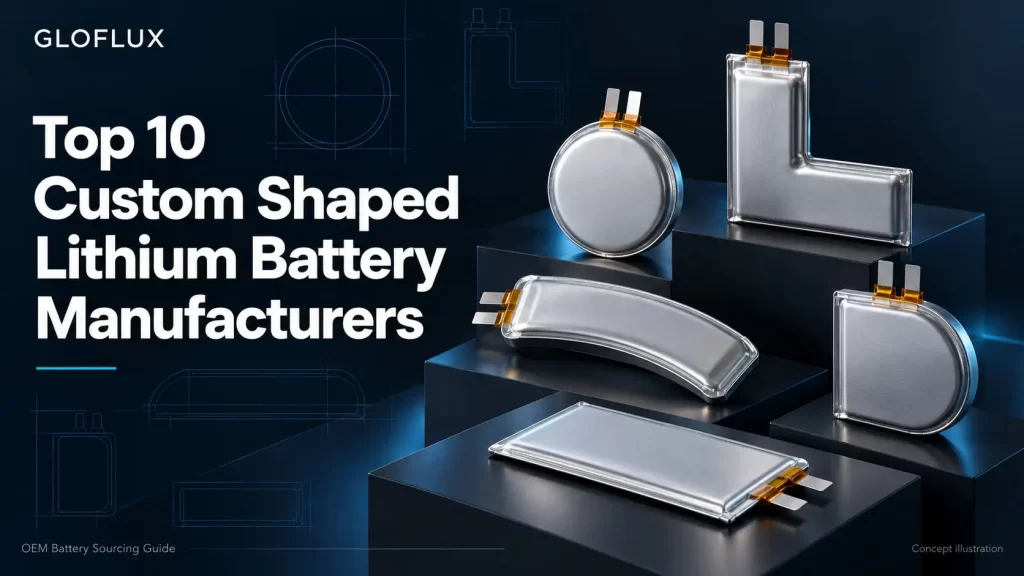
A custom shaped lithium battery is designed with dimensions or geometry that suit a particular device enclosure. In compact electronics, this often means a rechargeable lithium polymer pouch cell with a curved, circular, or irregular profile.
For example, GREPOW and Blue Power advertise shaped pouch batteries in formats including curved, round, L-shaped, D-shaped, and C-shaped designs. Available options depend on the manufacturer and project requirements. GREPOW shaped batteries, Blue Power special-shaped batteries.
Before contacting suppliers, distinguish between two requirements:
- Custom cell geometry: The battery cell itself must have a particular shape.
- Custom battery pack geometry: Cells, protection electronics, wiring, and an enclosure must form an assembly that fits the product.
A supplier’s custom pack service does not automatically establish that every irregular cell shape is available. Specify which type of customization your project needs.
Custom Shaped Lithium Battery Manufacturers at a Glance
The capabilities below summarize manufacturers’ published offerings. The final column suggests a useful starting point for your supplier discussions.
| Manufacturer | Publicly described capabilities | Key question for your project |
|---|---|---|
| Gloflux | Custom lithium battery solutions, pack engineering, and custom-shaped LiPo support | Can the proposed cell and complete assembly fit the available space? |
| GREPOW | Curved, round, L-, D-, and C-shaped pouch batteries | Is an existing shaped cell suitable, or is new tooling required? |
| Blue Power | Curved, circular, and irregular batteries | Which geometry is practical for the required capacity? |
| Honcell | Curved and irregular lithium-ion batteries with OEM/ODM customization | Can the supplier meet both mechanical and electrical requirements? |
| Padre Electronics | Curved, round, crescent, thin, and narrow polymer batteries | What curvature and dimensions can be produced? |
| LiPol Battery | Round, curved, cylindrical, and ultra-slim LiPo batteries | Can an existing model reduce development work? |
| DNK Power | Special-shaped lithium battery solutions for OEM/ODM projects | What changes would improve manufacturability? |
| Hanery | Custom LiPo dimensions and shapes, including curved and round designs | What sample validation is available for the proposed cell? |
| LithoTop | Curved, round, C-, U-, and other irregular LiPo geometries | Which dimensions and tolerances can be guaranteed? |
| LanDazzle | Shaped pouch cells and battery system customization | How will cell geometry and protection electronics be integrated? |
1. Gloflux
Gloflux provides custom lithium battery solutions for OEMs, engineers, and sourcing teams. Its published customization process covers needs assessment, cell sourcing, engineering design, prototype testing, and mass production. Options include battery size, voltage, capacity, wiring, and pack configuration. Gloflux custom battery solutions.
Gloflux also describes support for ultra-thin and custom-shaped LiPo designs in its beauty-device battery content. The suitability of a particular geometry should be evaluated against the enclosure, electrical load, and charging requirements. Gloflux custom-shaped LiPo capabilities.
For buyers, this makes Gloflux a candidate when the project requires coordination between the battery and the complete device. An initial discussion should establish whether the solution needs a new cell geometry, a customized pack assembly, or an existing cell with adapted wiring and protection.
What to discuss: Available installation space, target runtime, continuous and peak current, connector position, and expected production volume.
Explore Gloflux’s custom battery services to begin a project assessment.
2. GREPOW
GREPOW publishes a dedicated range of shaped pouch batteries, including curved, round, L-shaped, D-shaped, and C-shaped options. Its curved battery page includes example models and customization information for applications such as wristbands, smart rings, and smart glasses. GREPOW curved lithium polymer batteries.
Its published product information provides a starting point for comparing existing geometries with a new design.
What to discuss: Required curvature, maximum thickness, tab location, and whether a catalog model can meet the enclosure requirements.
3. Blue Power
Blue Power specializes in special-shaped batteries and battery packs. Its website lists C-shaped, curved, D-shaped, L-shaped, round, and ultra-thin batteries, with customization of dimensions and curvature. Published applications include wearable devices, robots, and medical equipment. Blue Power special-shaped battery solutions.
Buyers evaluating complex internal layouts can use these advertised shape categories to start a feasibility discussion.
What to discuss: Which parts of the enclosure are available for the battery, which areas must remain clear, and how much capacity is achievable within those constraints.
4. Honcell
Honcell describes OEM and ODM lithium-ion battery customization covering cylindrical, flat, curved, and irregular shapes. Its website also identifies a custom curved LiPo battery offering. Honcell lithium-ion battery manufacturing.
This makes it a relevant supplier to investigate when the project combines a nonstandard form with specific electrical requirements.
What to discuss: The exact cell profile, operating conditions, discharge requirements, and responsibility for protection circuit integration.
5. Padre Electronics
Padre Electronics manufactures lithium polymer cells and battery packs. Its published product range includes curved, round, crescent, ultra-thin, and ultra-narrow batteries. The company also describes an in-house mold workshop. Padre Electronics manufacturing capabilities.
Its curved battery page states that size, curving angle, and capacity can be customized for different requirements. Padre curved battery customization.
What to discuss: The proposed radius or curve angle, dimensional limits, tooling requirements, and sample acceptance criteria.
6. LiPol Battery
LiPol Battery advertises round, ultra-slim, curved, and cylindrical lithium polymer batteries, alongside dimension and capacity customization. Its shaped-battery page includes existing product categories that buyers can review before commissioning a new design. LiPol customized shaped batteries.
For a project with some enclosure flexibility, comparing existing models may help identify whether full customization is necessary.
What to discuss: The closest available model, the extent of required changes, and separate commercial terms for existing and newly developed cells.
7. DNK Power
DNK Power describes special-shaped lithium battery solutions for OEM and ODM projects. Its design guidance addresses the relationship between product space, battery performance, cost, and reliability. DNK Power special-shape LiPo battery design.
The company is worth evaluating during early product development, when enclosure details and battery requirements can still be adjusted together.
What to discuss: Geometry feasibility, space for the finished assembly, sample development stages, and the information required for an engineering review.
8. Hanery
Hanery’s lithium polymer battery offering includes custom dimensions and special shapes such as curved, round, and ultra-thin cells. Its website also describes services covering engineering, samples, manufacturing, and quality control. Hanery custom lithium polymer batteries.
Buyers can assess whether these capabilities match both the requested cell format and the level of development support needed.
What to discuss: The proposed cell drawing, sample test conditions, agreed performance limits, and how production changes are communicated.
9. LithoTop
LithoTop advertises special-shape LiPo batteries in geometries including C-shape, U-shape, curved, round, fan, trapezoid, and other irregular structures. Its product page focuses on batteries for space-limited devices. LithoTop special-shape LiPo batteries.
Its published range makes it a candidate for projects where the available compartment has an unusual outline.
What to discuss: Critical dimensions, tab orientation, achievable tolerances, and clearance requirements for the assembled product.
10. LanDazzle
LanDazzle describes custom shaped pouch batteries in curved, round, L-, D-, and C-shaped formats. Its offering also includes cell design, structural design, and BMS integration. LanDazzle special-shape battery solutions.
This combination is relevant to buyers who need to consider the cell and its supporting electronics together.
What to discuss: Space allocation between the cell and protection electronics, connection requirements, and the validation plan for the complete battery assembly.
How to Choose a Custom Shaped Lithium Battery Manufacturer
A useful comparison goes beyond the number of shapes listed on a website. Ask each supplier to respond to the same project specification so that differences in scope and assumptions are visible.
Define the Complete Installation Space
Provide a drawing of the available battery compartment, including restricted areas and connector locations. Ask for a drawing of the finished battery assembly, including tabs, protection components, insulation, and wiring.
A cell that fits on its own may require additional space once integrated into a finished assembly.
Compare Performance Under the Same Conditions
Ask suppliers to state the conditions behind their capacity, cycle life, charging, and discharge claims. Your comparison should identify:
- Nominal and maximum charging voltage.
- Minimum guaranteed capacity.
- Continuous current and peak current duration.
- Charge and discharge temperature limits.
- Cycle test conditions and end-of-life criteria.
- Required dimensional clearance.
Do not assume that the highest capacity, fastest charging, and thinnest construction advertised across a product range are available in the same custom model.
Request Documentation for the Proposed Design
Ask which test reports and supporting documents apply to the exact cell and pack being quoted. Have the supplier identify any additional evaluation needed if the geometry, materials, or assembly changes.
Keep the proposed model number, drawing revision, and supporting documentation aligned throughout development.
Separate Development Costs From Unit Pricing
Request individual figures for engineering work, tooling, samples, testing, and production. Compare minimum order quantities, sample schedules, and production lead times separately.
This makes it easier to judge the total project cost and understand what must happen before production can begin.
Agree on Sample Acceptance Criteria
Before ordering samples, define what constitutes a successful result. Include mechanical fit, electrical performance, charging behavior, and performance in the intended device.
A written acceptance plan helps both teams resolve issues before the design is released for volume production.
What to Include in Your Battery RFQ
A clear request for quotation helps manufacturers assess feasibility and provide comparable proposals.
| RFQ item | Information to provide |
|---|---|
| Application | Product type and intended use |
| Mechanical drawing | Available dimensions, shape, curvature, and restricted areas |
| Voltage | Nominal voltage and charging architecture |
| Capacity | Minimum capacity or target runtime |
| Load profile | Average current, peak current, and pulse duration |
| Charging target | Available charge current and desired charge time |
| Environment | Operating and storage conditions |
| Connections | Connector type, polarity, wire length, and exit direction |
| Protection | Required protection functions and temperature sensing |
| Documentation | Destination markets and requested test documentation |
| Volume | Sample quantity, initial order, and annual forecast |
| Schedule | Prototype deadline and planned production start |
If your project serves the wearable market, you can also review Gloflux’s smart wearable battery solutions before preparing the RFQ.
Frequently Asked Questions
Can a lithium battery be manufactured in any shape?
Manufacturers advertise a variety of curved and irregular formats, but a proposed shape still requires engineering review. Send the enclosure drawing and electrical requirements together so the supplier can evaluate a practical design.
What is the difference between a curved battery and a flexible battery?
A curved battery has a specified curved geometry. That description alone does not establish that it can be repeatedly bent during use. If movement is part of your application, explicitly request the permitted bending conditions and supporting validation.
Are custom shaped lithium batteries more expensive?
A new design can introduce engineering, tooling, sample, and testing costs. Request a comparison between an existing model, a modified existing design, and a fully custom solution to determine the cost for your project.
What is the minimum order quantity?
MOQ depends on the supplier, model, tooling, and production requirements. Ask separately about prototype quantities, pilot production, and repeat orders.
How long does custom battery development take?
The schedule depends on design complexity, material availability, tooling, testing, and sample revisions. Request milestones for feasibility review, drawing approval, sample delivery, validation, and production.
How do I choose the right manufacturer?
Choose a supplier that can explain the proposed design, document its performance, produce acceptable samples, and support your forecast volume. Evaluate its response to your actual specification rather than relying on a general capability statement.
Discuss Your Custom Battery Project With Gloflux
Developing a compact device starts with understanding how the battery will fit and perform inside the product.
Send Gloflux your enclosure drawing, voltage, capacity or runtime target, load profile, and expected quantity. Our team can review your requirements and discuss a suitable development path through our custom lithium battery service.
Talk to the Manufacturer
Resources & Insights
High Capacity Lithium Battery for Wearables: High-Voltage LiPo Cell Design
2026-10-19
Cylindrical Battery Packs for Laptops: 2S vs 3S vs 4S Battery Design
2026-10-19
Stage Lighting Battery Pack: Prevent Voltage Drop & LED Flicker
2026-10-19

Best Rechargeable Batteries for Smart Devices: Performance, Safety, and Selection Guide
2026-10-19


