


 Home /
U-Shaped Lithium Battery: Design, Applications, and OEM Customization


Table of Contents
- What Is a U-Shaped Lithium Battery?
- Why Use a U-Shaped LiPo Battery?
- Potential Applications for U-Shaped Batteries
- U-Shaped vs. L-Shaped vs. Rectangular Batteries
- Key Design Requirements for a U-Shaped Lithium Battery
- When Is a U-Shaped Battery Worth Considering?
- What to Include in a U-Shaped Battery RFQ
- From Feasibility Review to Production
- Discuss Your U-Shaped Battery Requirements With Gloflux
-
Frequently Asked Questions
- What is a U-shaped LiPo battery?
- Does a U-shaped battery provide longer runtime?
- Can a standard pouch battery be bent into a U shape?
- Is a U-shaped battery flexible?
- What is the difference between U-shaped and L-shaped batteries?
- What is the minimum order quantity?
- Can Gloflux assess a U-shaped battery project?
- Start With Your Product Drawing
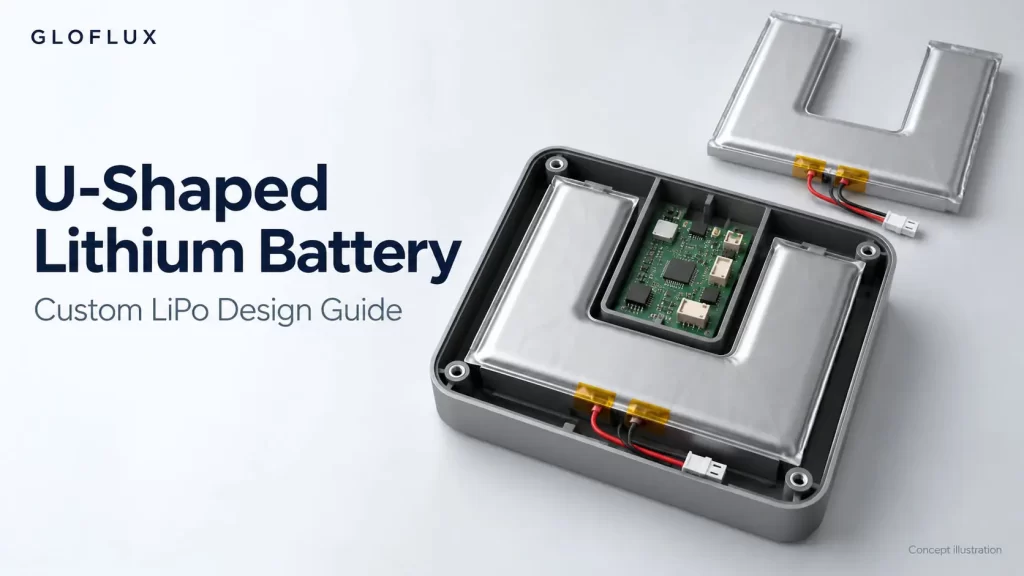
A U-shaped lithium battery can help engineers use the space around a central component inside a compact device. Instead of occupying one rectangular area, its footprint extends along two sides and connects across a base, leaving an opening between the arms.
This geometry may be useful when a sensor, circuit board, connector assembly, or structural feature prevents a conventional battery from filling the available compartment.
However, a U-shaped outline alone does not guarantee better runtime or a more practical product. The design must also meet electrical, mechanical, manufacturing, and sourcing requirements.
This guide explains how U-shaped batteries work as a packaging solution and what OEM buyers should evaluate before requesting samples.
What Is a U-Shaped Lithium Battery?
A U-shaped lithium battery has a footprint resembling the letter “U.” In compact electronics, this commonly refers to a rechargeable lithium polymer pouch cell manufactured with two arms joined by a connecting section.
Commercial U-shaped pouch cells are available in different dimensions and electrical specifications. Their purpose is to use irregular installation space more effectively. U-shaped pouch cell examples.
It is useful to distinguish two possible designs:
| Design | Description | What requires evaluation |
|---|---|---|
| Single U-shaped cell | One manufactured cell with a U-shaped footprint | Cell geometry, achievable capacity, tooling, and electrical performance |
| U-shaped battery pack | Multiple cells and supporting components arranged in a U-shaped assembly | Cell configuration, interconnections, protection, and finished dimensions |
The shape does not define the battery’s voltage, capacity, or charging limits. Those specifications depend on the selected cell or pack design.
Why Use a U-Shaped LiPo Battery?
Fit Around a Central Obstruction
The main opportunity is mechanical: the opening between the arms can accommodate a component that would otherwise interrupt the battery compartment.
Special-shaped battery manufacturers identify U-shaped designs as an option for using space around internal structures in wearables and compact instruments. Special-shape battery applications.
Consider a device with a sensor module extending from one edge toward the center. A rectangular battery may fit only beneath it. A U-shaped design could potentially occupy the space beneath the module and on both sides.
Whether this arrangement is worthwhile depends on the actual drawing and the manufacturer’s feasibility assessment.
Evaluate More Capacity Within a Fixed Enclosure
Using additional installation space may allow a larger-capacity solution without increasing the enclosure size.
That possibility should be evaluated at the complete assembly level. Compare the proposed U-shaped battery with an existing rectangular cell after accounting for seals, electronics, wiring, and installation clearances.
Better space utilization does not automatically mean higher energy density. Ask how much usable energy each proposed solution can deliver within the same permitted space.
Support Product Layout Decisions
A U-shaped battery may give the mechanical and electronics teams another layout option when several components must share a small enclosure.
Include battery engineering early enough to compare alternatives. A minor adjustment to the PCB or connector location could make an existing cell suitable, while a fixed central obstruction may justify a shaped design.
Potential Applications for U-Shaped Batteries
Published applications include portable sports and medical equipment, while other manufacturers identify wearables and compact instruments as possible uses. Suitability remains specific to the product. U-shaped battery applications, Special-shape battery selection.
The following are design scenarios worth evaluating:
| Product scenario | Potential reason to consider a U-shaped layout |
|---|---|
| Wearable monitoring device | Space remains on both sides of a sensing module |
| Compact instrument | A central board or connector interrupts the battery compartment |
| Portable healthcare device | Electronics and battery must share a constrained enclosure |
| Sports electronics | A mounting feature occupies part of the internal space |
| Custom handheld product | Existing component positions leave a U-shaped installation area |
These examples describe possible layouts, not confirmed compatibility with any particular battery model.
For wearable projects, explore Gloflux’s smart wearable battery solutions alongside your enclosure requirements.
U-Shaped vs. L-Shaped vs. Rectangular Batteries
Choose the geometry based on the available compartment rather than the appearance of the battery.
| Battery footprint | Layout worth evaluating | Main design question |
|---|---|---|
| U-shaped | Space exists on two sides of a central obstruction and across its base | Are the arms and connecting section practical to manufacture? |
| L-shaped | A corner is occupied, leaving two adjoining areas available | Can the battery use the remaining corner-shaped space effectively? |
| Rectangular | The compartment provides an uninterrupted rectangular area | Can an existing model meet the fit and runtime requirements? |
A useful supplier request is to compare a standard option with a shaped option using the same installation boundaries and electrical requirements.
Key Design Requirements for a U-Shaped Lithium Battery
1. Define the Opening Between the Arms
Overall length and width are not enough to describe a U-shaped battery.
Provide a drawing that specifies:
- Overall length, width, and maximum thickness.
- Width and length of each arm.
- Width and depth of the central opening.
- Width of the connecting base.
- Inner and outer corner requirements.
- Tab positions and wire exit direction.
Do not assume the arms must be symmetrical. If the enclosure is asymmetric, submit the actual available space and let the manufacturer assess feasible geometry.
2. Include Clearances Around the Central Component
Treat the central opening as an installation boundary, not simply an empty shape on a drawing.
Ask the supplier and mechanical team to review component tolerances, assembly access, movement, and separation from surrounding surfaces. Pouch-cell integration requires appropriate support and allowance for dimensional changes; nominal dimensions alone are insufficient for enclosure design. Jauch lithium polymer battery technical guide.
3. Request the Finished Assembly Drawing
A bare cell outline does not show the complete space requirement.
The approved drawing should include seals, tabs, protection electronics, insulation, wiring, and connectors. Ask where each component will sit and how the battery will be installed and retained.
This review is particularly useful when the opening leaves limited room for wire routing.
4. Specify the Device’s Load Profile
Provide the manufacturer with normal operating current, standby demand, continuous maximum current, and peak-current duration.
If the product uses a radio, motor, display, or other intermittent load, describe its operating pattern. A runtime target becomes more useful when the supplier understands how the product consumes energy.
Request achievable capacity for the proposed geometry rather than assuming it from the battery’s outer dimensions.
5. Confirm Charging and Protection Requirements
Match the charging system to the approved battery specification. The U-shaped footprint does not establish the maximum charge voltage, permitted current, or operating temperature limits. Jauch lithium polymer battery technical guide.
Clarify which protection and monitoring functions are included in the battery assembly and which are provided by the device.
6. Review the Surrounding Thermal Environment
Identify components near the battery that produce heat during normal operation or charging.
Include simultaneous operating conditions in the engineering discussion—for example, a device transmitting data while charging. Ask the supplier to define appropriate validation conditions for the proposed battery and installation.
A geometry that fits mechanically still needs to be evaluated in the working product.
When Is a U-Shaped Battery Worth Considering?
A custom U-shaped design deserves further investigation when:
- The enclosure has a fixed central obstruction.
- Usable space remains on both sides of that obstruction.
- An existing rectangular battery cannot meet the runtime target.
- The expected product volume can support the development effort.
- The mechanical and electrical teams can validate prototypes before production.
An existing battery may be the more practical choice when a small enclosure change resolves the space problem.
Gloflux’s custom battery guidance identifies existing cells and established components as factors that can help reduce development complexity and support smaller initial orders. Gloflux guidance on custom battery projects.
What to Include in a U-Shaped Battery RFQ
A detailed RFQ helps the supplier distinguish a feasible concept from a drawing that still requires adjustment.
| RFQ requirement | Information to provide |
|---|---|
| Application | Product type and intended use |
| Architecture | Single U-shaped cell, shaped pack, or open to either |
| Mechanical drawing | Outer dimensions, arm dimensions, central opening, and thickness |
| Restricted areas | Components, mounting points, and cable routes |
| Voltage | Required operating range and charging architecture |
| Runtime or capacity | Target runtime and minimum capacity, if established |
| Electrical load | Average, continuous maximum, and peak current |
| Environment | Operating and storage conditions |
| Connections | Connector, polarity, wire length, and exit direction |
| Protection | Required protection and temperature monitoring |
| Documentation | Target markets and requested supporting reports |
| Quantity | Prototype, pilot, and annual production forecast |
| Schedule | Sample and production milestones |
Mark requirements as either fixed or negotiable. This allows the manufacturer to propose useful changes while preserving essential product constraints.
From Feasibility Review to Production
For a U-shaped battery project, ask the supplier to propose a development plan with clear approval points.
- Requirements review: Confirm mechanical boundaries, electrical needs, and commercial targets.
- Concept comparison: Evaluate available cells, a new shaped cell, and alternative pack arrangements.
- Drawing approval: Agree on the proposed assembly and unresolved requirements.
- Prototype evaluation: Check installation, runtime, charging behavior, and operation in the device.
- Design release: Finalize specifications, documentation, and production acceptance criteria.
- Pilot and production: Confirm repeatability before scaling the approved design.
Request separate estimates for engineering, tooling, samples, testing, and production. A single unit price does not explain the full cost of a new battery design.
Discuss Your U-Shaped Battery Requirements With Gloflux
Gloflux provides custom LiPo and lithium battery pack services covering dimensions, voltage, capacity, protection electronics, wiring, connectors, and enclosures. Its published process includes requirements assessment, engineering, prototype testing, and mass production. Gloflux custom battery solutions.
For a U-shaped installation space, begin with a drawing-based review. The assessment should establish whether a shaped cell, a custom pack arrangement, or a modified product layout offers a practical solution.
Specific U-shaped cell availability, capacity, tooling, order quantities, and delivery schedules require project-level confirmation.
Frequently Asked Questions
What is a U-shaped LiPo battery?
It is a lithium polymer battery with a footprint consisting of two arms connected across a base, leaving an opening between them. Confirm whether the supplier is offering a single shaped cell or a multi-cell assembly.
Does a U-shaped battery provide longer runtime?
It may allow more capacity if it uses space that another design leaves empty. Runtime still depends on the proposed battery’s usable energy and the device’s power consumption. A supplier comparison and device testing are needed.
Can a standard pouch battery be bent into a U shape?
No. A standard pouch cell should not be bent, cut, or otherwise modified to create a U-shaped outline. A shaped cell must be manufactured for its intended geometry. Jauch lithium polymer battery technical guide.
Is a U-shaped battery flexible?
The shape alone does not establish flexibility. If your product requires repeated bending or movement, specify that requirement separately and request supporting validation.
What is the difference between U-shaped and L-shaped batteries?
A U-shaped footprint has two arms joined by a base and can fit around three sides of an obstruction. An L-shaped footprint has two adjoining arms and may suit space remaining around a corner obstruction.
What is the minimum order quantity?
MOQ depends on the available model, customization scope, tooling, and production requirements. Ask separately about prototypes, pilot orders, and regular production.
Can Gloflux assess a U-shaped battery project?
Gloflux offers custom battery engineering and prototype services. Submit the enclosure drawing and electrical requirements for assessment. A specific U-shaped design must be confirmed through the engineering review.
Start With Your Product Drawing
A useful U-shaped battery proposal begins with a clear description of the available space and required performance.
Send Gloflux your enclosure drawing, central opening dimensions, voltage range, runtime target, load profile, and expected quantity.
Talk to the Manufacturer
Resources & Insights

High Capacity Lithium Battery for Wearables: High-Voltage LiPo Cell Design
2026-10-19
Cylindrical Battery Packs for Laptops: 2S vs 3S vs 4S Battery Design
2026-10-19

Stage Lighting Battery Pack: Prevent Voltage Drop & LED Flicker
2026-10-19

Best Rechargeable Batteries for Smart Devices: Performance, Safety, and Selection Guide
2026-10-19


