Home /
7.4V Battery Packs for Electric Breast Pumps: Design Guide


Table of Contents
- 1. Understanding the 7.4V Lithium Battery Configuration
- 2. Is a 7.4V Battery Suitable for Every Electric Breast Pump?
- 3. Choosing the Right Capacity for a 7.4V Breast Pump Battery
- 4. Lithium Polymer vs. Cylindrical Cells for 7.4V Battery Packs
- 5. Battery Protection and Charging Circuit Design
- 6. Mechanical Design Requirements for OEM Battery Integration
- 7. What Information Should OEM Manufacturers Provide?
- Frequently Asked Questions
- Conclusion
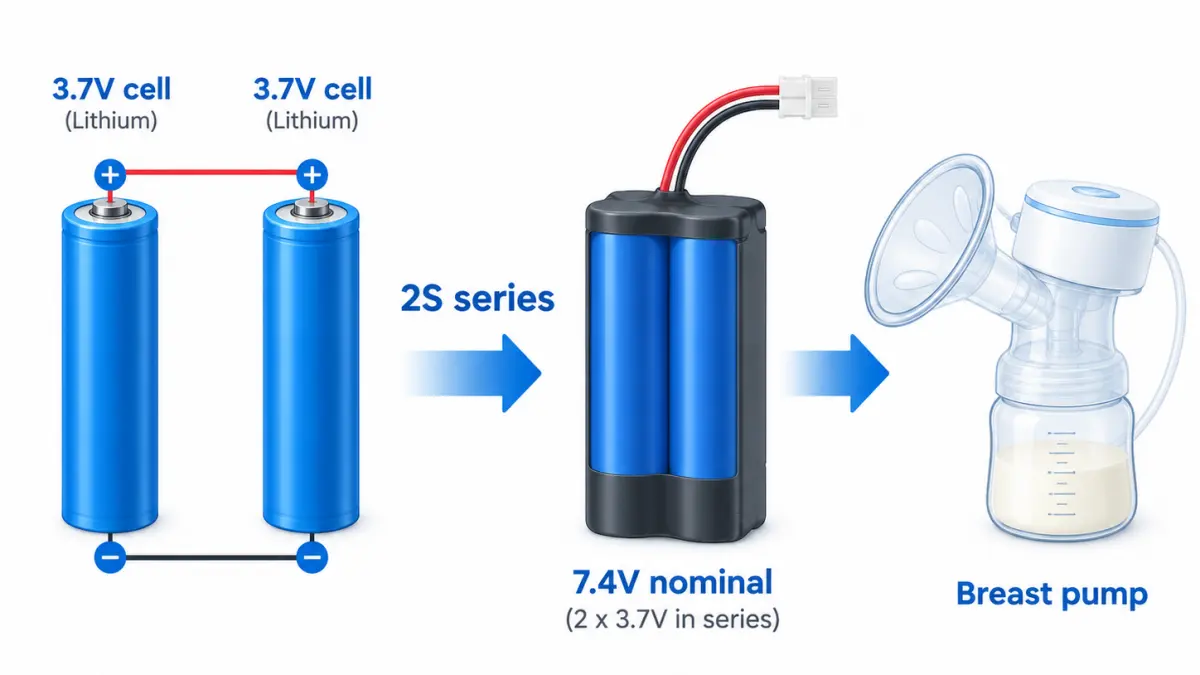
Battery selection is an important part of developing a rechargeable electric breast pump. The battery must support the motor and control electronics while fitting within the device's mechanical and electrical design.
For manufacturers developing a pump that uses a two-cell lithium-ion power architecture, a 7.4V Breast Pump Battery can be considered as a custom power solution. However, choosing the correct battery involves more than matching the nominal voltage. Engineers must also evaluate operating current, battery capacity, charging characteristics, protection requirements, and available installation space.
This guide explains the key design considerations for OEM and ODM electric breast pump manufacturers.
1. Understanding the 7.4V Lithium Battery Configuration
A 7.4V lithium-ion battery pack commonly uses two nominal 3.7V cells connected in series, known as a 2S configuration.
Connecting cells in series increases the overall voltage while maintaining the same ampere-hour capacity as an individual cell, assuming identical cell capacities.
For a conventional 3.7V nominal lithium-ion chemistry, a typical configuration has the following electrical characteristics:
| Parameter | Typical 2S Configuration |
|---|---|
| Battery configuration | 2S1P |
| Nominal voltage | 7.4V |
| Typical full-charge voltage | 8.4V |
| Example rated capacity | 2000mAh |
| Nominal energy | 14.8Wh |
| Cell options | Suitable cylindrical or lithium polymer cells |
| Protection requirements | Overcharge, overdischarge and overcurrent protection |
The figures above describe an example using conventional 4.2V maximum-charge lithium-ion cells. Actual voltage limits depend on the selected chemistry and cell specifications.
A 7.4V nominal battery should not automatically be treated as a direct replacement for a pump originally designed for a different voltage.
2. Is a 7.4V Battery Suitable for Every Electric Breast Pump?
Not every electric breast pump is designed for a 7.4V battery system.
Different pump designs can use different electrical architectures depending on motor selection, control circuitry, physical dimensions, and charging requirements.
Motor and Control Circuit Compatibility
Before selecting a 7.4V battery, manufacturers should establish the allowable voltage range of the complete device.
Important questions include:
- What voltage range does the motor driver support?
- What is the pump's average operating current?
- What is the maximum startup or peak current?
- Does the device use a voltage regulator?
- At what voltage does the control system stop operation?
These parameters determine whether a 2S lithium battery pack is appropriate.
A pack's nominal voltage alone does not establish compatibility with the motor or control electronics.
Battery Voltage During Operation
A conventional 2S lithium-ion pack does not remain at exactly 7.4V throughout discharge.
Its terminal voltage changes depending on the state of charge, operating current, temperature, and cell characteristics.
The pump's electrical design must therefore accommodate the intended battery voltage range rather than relying on a constant nominal value.
For compact single-cell alternatives, manufacturers can also review our guide on choosing a wearable breast pump battery.
3. Choosing the Right Capacity for a 7.4V Breast Pump Battery
Battery capacity determines how much electrical charge a pack can deliver under specified conditions.
However, capacity alone cannot determine the exact operating time of an electric breast pump.
Manufacturers should consider:
- Average power consumption during a pumping session
- Peak current when the motor starts or changes operating conditions
- Required operating time between charges
- Voltage-conversion efficiency
- Battery discharge cutoff settings
- Space available for the battery pack
Example: Comparing Battery Energy
Consider three hypothetical 7.4V battery configurations.
| Nominal Voltage | Capacity | Nominal Energy |
|---|---|---|
| 7.4V | 1200mAh | 8.88Wh |
| 7.4V | 2000mAh | 14.8Wh |
| 7.4V | 3000mAh | 22.2Wh |
These are calculation examples rather than specifications for an existing Gloflux breast pump battery model.
A higher-capacity pack provides more nominal stored energy at the same voltage, but may require additional installation space or a different battery structure.
The correct capacity should be selected after evaluating the device's power consumption and operating requirements.
For a detailed estimation method, read our article on breast pump battery life and capacity calculation.
4. Lithium Polymer vs. Cylindrical Cells for 7.4V Battery Packs
The battery cell format influences the mechanical layout of a rechargeable breast pump.
Lithium Polymer Pouch Cells
Lithium polymer pouch cells are available in a range of thicknesses and dimensions.
They may be suitable for designs where battery height and enclosure geometry are important constraints.
A two-cell series configuration can be developed using compatible pouch cells when the mechanical and electrical requirements support it.
Cylindrical Lithium-Ion Cells
Cylindrical lithium-ion cells, including 18650 cells, offer a standardized physical format.
They may be considered for breast pump products with sufficient internal space and a compatible mechanical structure.
However, a cylindrical cell pack is not automatically preferable to a pouch-cell solution. The selection depends on dimensions, electrical performance, mechanical retention, and manufacturing requirements.
Our comparison of lithium polymer and 18650 breast pump batteries discusses the trade-offs between these two approaches.
5. Battery Protection and Charging Circuit Design
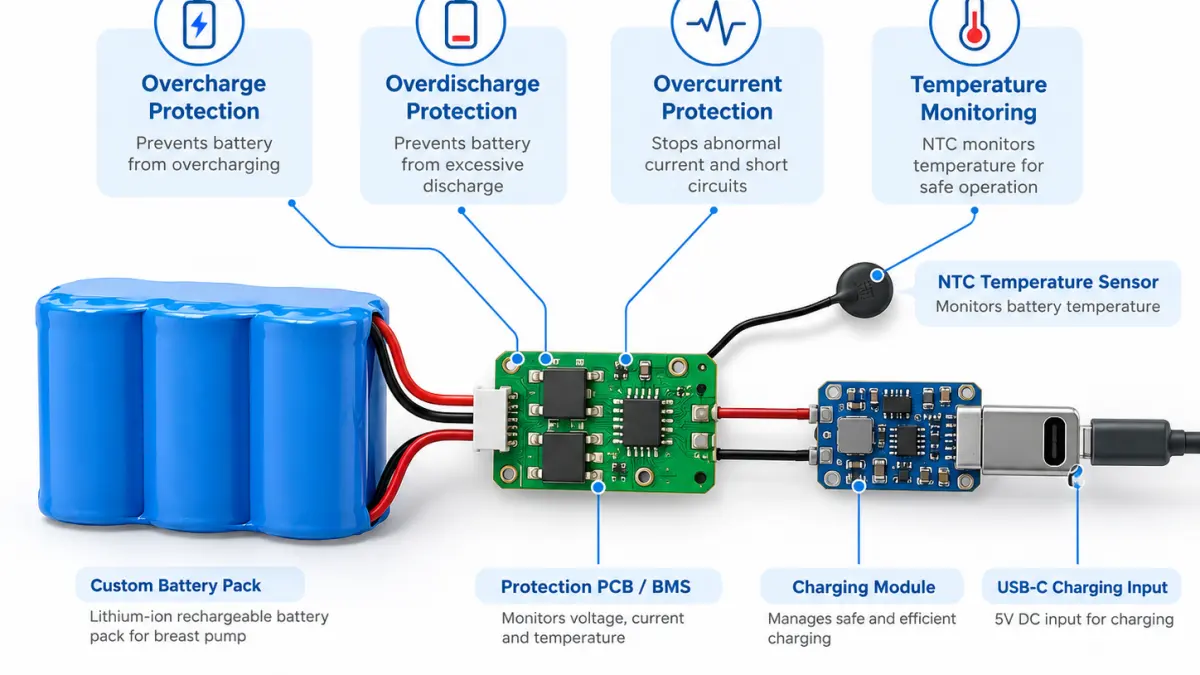
Battery protection is a critical engineering consideration when developing a 7.4V rechargeable breast pump.
For a two-cell lithium-ion configuration, the protection design may need to address:
Overcharge protection: Prevents the battery from exceeding defined cell voltage limits.
Overdischarge protection: Helps prevent cells from operating below their specified discharge limits.
Overcurrent protection: Responds to abnormal current conditions according to the protection circuit design.
Short-circuit protection: Helps limit electrical hazards associated with output short circuits.
Cell monitoring and balancing: May be required to manage differences between series-connected cells, depending on the pack architecture.
Temperature monitoring: Can be implemented using an NTC thermistor or another suitable temperature-sensing method.
Charging Compatibility
The charging circuit must be designed for the correct cell chemistry, number of series-connected cells, voltage limits, and charge-current requirements.
For example, a conventional 2S pack using cells rated for a maximum charge voltage of 4.2V per cell typically requires an 8.4V maximum charging voltage.
The device's USB-C connector, where fitted, does not independently determine the appropriate battery charging voltage. The charger and power-management circuit must provide the necessary control.
The final charging and protection design should be verified through electrical testing.
6. Mechanical Design Requirements for OEM Battery Integration
Battery dimensions are particularly important when integrating a custom pack into an electric breast pump housing.
Manufacturers should provide the available battery compartment dimensions and the location of nearby components.
Design considerations include:
- Maximum battery length, width, and thickness
- Battery installation orientation
- Connector type and cable length
- Position of the charging and control PCB
- Mechanical support and retention
- Allowance for manufacturing tolerances
- Protection from compression, vibration, and other mechanical stress
For pouch-cell batteries, the enclosure must also allow for the mechanical and safety requirements specified by the cell manufacturer.
Mechanical design and battery selection should be reviewed together before prototypes are finalized.
7. What Information Should OEM Manufacturers Provide?
To evaluate a custom 7.4V breast pump battery project, the development team should prepare the following information:
- Required nominal battery voltage and allowable operating range
- Target capacity and runtime
- Continuous operating current and peak current
- Available battery compartment dimensions
- Required connector, wiring, and polarity
- Charging circuit specifications
- Battery protection and temperature-monitoring requirements
- Target order quantity and applicable market requirements
Providing these details helps reduce uncertainty during battery pack evaluation and sample development.
Manufacturers planning a new rechargeable breast pump can explore Gloflux's custom lithium battery solutions.
Frequently Asked Questions
1. What does 7.4V mean on a breast pump battery?
For a conventional lithium-ion system, 7.4V commonly indicates two nominal 3.7V cells connected in series. It refers to the pack's nominal voltage, not a constant operating voltage.
2. Can a 7.4V lithium battery replace a 3.7V battery?
Not directly. A replacement requires verification of the motor, charging circuit, electronic controls, protection system, and operating voltage range.
3. Is a 7.4V 2000mAh battery suitable for an electric breast pump?
It may be suitable for a device designed for that voltage and power requirement. Actual suitability depends on current demand, available space, runtime targets, and electrical compatibility.
4. Does a 7.4V battery need a protection circuit?
Rechargeable lithium-ion packs require an appropriate safety design. A 2S pack commonly incorporates protection against abnormal voltage and current conditions, with additional monitoring as required by the application.
5. Can manufacturers customize the size of a 7.4V breast pump battery?
Battery pack dimensions can be tailored through suitable cell selection and pack design, subject to the physical dimensions and safety requirements of the selected cells.
Conclusion
A 7.4V Breast Pump Battery is a potential power solution for electric breast pumps designed around a compatible two-cell lithium-ion architecture.
For OEM manufacturers, successful battery integration requires coordinated evaluation of voltage, current, capacity, mechanical dimensions, charging, and protection requirements.
Gloflux supports B2B custom lithium battery development for equipment manufacturers. To discuss an application-specific battery pack, submit your electrical specifications, dimensional requirements, and expected production quantity through our OEM battery customization page.