


 Home /
How to Choose the Right Battery for a Wearable Breast Pump


Table of Contents
- 1. Start with the Battery Compartment, Not the Capacity
- 2. Match Battery Voltage to Motor Requirements
- 3. Calculate Capacity Based on Pumping Sessions
- 4. Check Motor Startup and Peak Discharge Current
- 5. Consider Weight, Heat, and User Comfort
- 6. Design Charging and Protection as One System
- 7. Select Battery Construction for the Product Design
- 8. Prepare the Right Information for OEM Customization
- Frequently Asked Questions
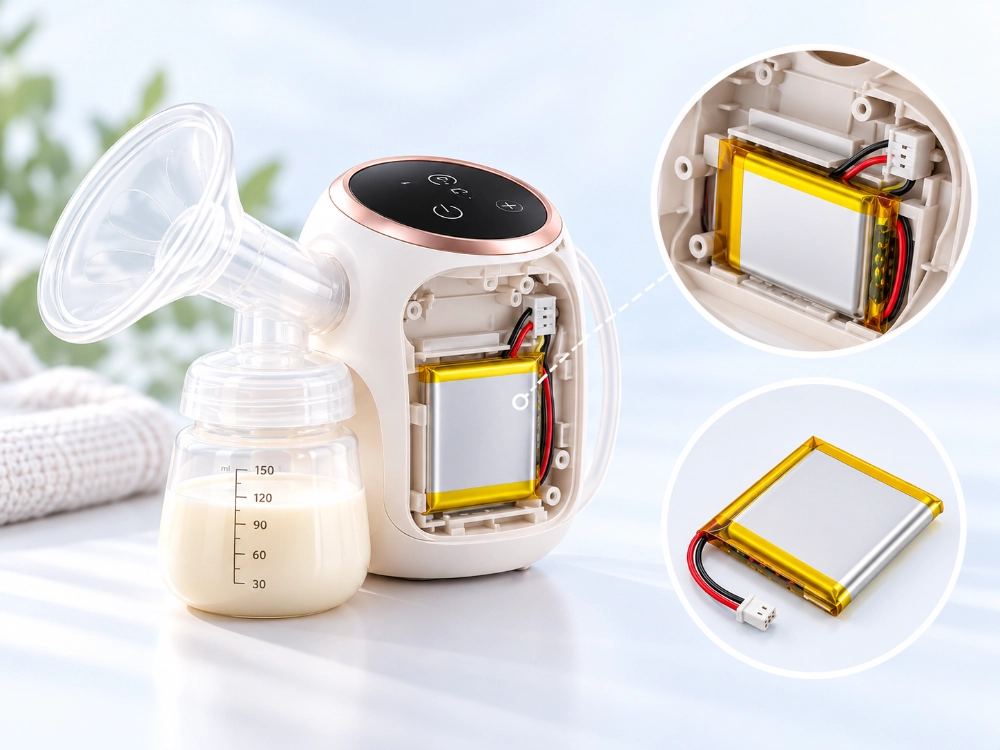
A well-designed wearable breast pump battery must deliver reliable power without making the device bulky, heavy, or uncomfortable to wear. For breast pump manufacturers, battery selection is closely connected to motor performance, internal packaging, charging design, and everyday usability.
Unlike conventional electric breast pumps with external power units, wearable models place the battery, motor, electronics, and collection components within a compact housing.
Choosing a battery therefore requires balancing electrical performance with mechanical integration. This guide explains the key factors OEM manufacturers should evaluate before finalizing a rechargeable battery solution.
1. Start with the Battery Compartment, Not the Capacity
In a wearable breast pump, every millimeter of internal space matters.
The battery must fit around components such as the suction motor, control PCB, milk collection chamber, and connecting structures. A battery that meets the electrical specifications may still be unsuitable if its shape interferes with assembly.
Before selecting a cell, manufacturers should determine:
- Maximum available length, width, and thickness
- Battery mounting position and orientation
- Space required for wiring and connectors
- Clearance from moving components
- Allowance for insulation and mechanical protection
Thin lithium polymer pouch cells are often considered for compact wearable designs because they offer flexible dimensions.
However, the cell must remain within its specified mechanical limits and should never be compressed to fit the enclosure.
2. Match Battery Voltage to Motor Requirements
Battery voltage must be compatible with the pump's electrical architecture.
Wearable breast pumps may use different motor drivers and power-management circuits. The appropriate voltage depends on the motor, electronics, and charging system.
Common lithium-ion configurations include:
| Configuration | Typical Nominal Voltage | Design Consideration |
|---|---|---|
| 1S | 3.7V | Compact single-cell architecture |
| 2S | 7.4V | Higher-voltage battery configuration |
| 3S | 11.1V | Requires compatible electrical design |
These are possible battery configurations, not standard voltage requirements for every breast pump.
For example, a 7.4V pack must not be used as a direct replacement for a device designed around a 3.7V battery.
OEM engineers should confirm the complete operating voltage range, motor-driver compatibility, and charging requirements before approving a battery design.
3. Calculate Capacity Based on Pumping Sessions
Manufacturers often focus on battery capacity in milliamp-hours, but the more useful starting point is the energy required for the intended pumping sessions.
Battery energy is calculated as:
Energy (Wh) = Nominal Voltage (V) × Capacity (Ah)
Consider a hypothetical wearable pump consuming an average of 5W.
If the device must operate for two hours, its estimated operating energy requirement is 10Wh.
Allowing for conversion losses, battery aging, and reserve capacity may increase the required nominal battery energy.
Actual requirements should be confirmed through device testing because power consumption changes with suction settings, motor operation, and control electronics.
A larger battery is not automatically better if the additional weight makes the pump uncomfortable.
4. Check Motor Startup and Peak Discharge Current
Breast pump motors do not necessarily draw constant current.
Current demand may increase during startup, changes in suction level, or operation under greater mechanical resistance.
A battery selected only for average current could experience excessive voltage drop when the motor starts.
For reliable performance, the battery specification should include:
- Normal operating current
- Maximum continuous discharge current
- Short-duration peak current
- Peak-current duration
- Acceptable voltage drop under load
Cell resistance, wiring, connector contacts, and protection-circuit performance should be evaluated together.
Testing with the actual pump motor is especially important before mass production.
5. Consider Weight, Heat, and User Comfort
Wearable breast pumps are designed to operate close to the body, making battery placement and heat management important.
Battery weight can influence the balance of the finished device. Poor weight distribution may affect comfort even when the total device weight is relatively low.
Manufacturers should also consider heat generated by the motor, charging electronics, and battery itself.
The battery should be positioned away from excessive heat sources, with adequate mechanical support and temperature monitoring where required.
Thermal testing should cover continuous operation, high suction settings, charging conditions, and foreseeable ambient temperatures.
For a compact wearable pump, effective thermal design is often more valuable than simply maximizing battery capacity.
6. Design Charging and Protection as One System
A rechargeable wearable breast pump needs a charging circuit compatible with its battery chemistry and cell configuration.
USB-C may provide the external power connection, but it does not independently manage lithium-ion cell charging.
Battery protection may include:
- Overcharge and over-discharge protection
- Short-circuit and overcurrent protection
- NTC temperature sensing
- Cell balancing for applicable multi-cell packs
- Appropriate connector and wiring protection
The charging system should be validated together with the battery pack and device electronics.
Manufacturers should also consider how charging ports, seals, and internal wiring are protected from moisture associated with cleaning and everyday use.
7. Select Battery Construction for the Product Design
A compact wearable pump may benefit from a customized pouch battery, while a larger portable model may accommodate cylindrical lithium-ion cells.
The choice should depend on the actual internal dimensions and performance requirements.
For a detailed comparison, see our guide to Lithium Polymer vs. 18650 Batteries for Breast Pumps.
The battery assembly may include protective insulation, a PCM/BMS, an NTC sensor, and a customized connector.
If a separate rigid plastic battery enclosure is required, its additional thickness and weight must be considered during product development.
8. Prepare the Right Information for OEM Customization
A battery manufacturer can evaluate a wearable breast pump project more efficiently when the customer provides accurate electrical and mechanical information.
Useful project details include battery voltage, required operating time, available dimensions, motor current, charging specifications, connector details, and expected production quantity.
Mechanical drawings or photographs of the existing battery compartment can also help identify integration limitations early.
Gloflux provides custom lithium battery solutions for OEM/ODM applications, including Li-Polymer Battery Packs, customized protection circuits, wiring, and connectors.
For wearable breast pump development, Gloflux can review the battery's electrical and physical requirements and discuss suitable options for prototype evaluation and future production.
Developing a wearable breast pump? Share your battery specifications, installation dimensions, and estimated order quantity with Gloflux to explore a customized battery solution.
Frequently Asked Questions
1. What battery type is suitable for a wearable breast pump?
Lithium polymer pouch batteries are often suitable for compact wearable designs. However, the final choice depends on available space, voltage, discharge requirements, and mechanical protection.
2. How much battery capacity does a wearable breast pump need?
Capacity depends on average power consumption and desired operating time. Manufacturers should calculate energy requirements in watt-hours and validate runtime through testing.
3. Can a wearable breast pump use a 7.4V battery?
Yes, if its motor, electronics, and charging system are specifically designed for a compatible 7.4V nominal battery pack.
4. Does a wearable breast pump battery need a protection circuit?
Rechargeable lithium battery systems require suitable safety controls. The appropriate protection architecture depends on the cells, charging circuit, and device design.
5. Can Gloflux customize battery dimensions and connectors?
Yes. Gloflux supports B2B battery pack customization, including dimensions, capacity, protection circuits, wiring, connectors, and assembly requirements for OEM/ODM projects.
Talk to the Manufacturer
Resources & Insights
How to Choose the Right Battery for a Wearable Breast Pump
2026-10-22
Lithium Polymer vs. 18650 Batteries for Breast Pumps: Which Is Better?
2026-10-22
High Capacity Lithium Battery for Wearables: High-Voltage LiPo Cell Design
2026-10-19
Cylindrical Battery Packs for Laptops: 2S vs 3S vs 4S Battery Design
2026-10-19


