


 Home /
 Custom 38.4V 30Ah LiFePO4 Battery Module for Robots with Wireless Charging Port


Table of Contents
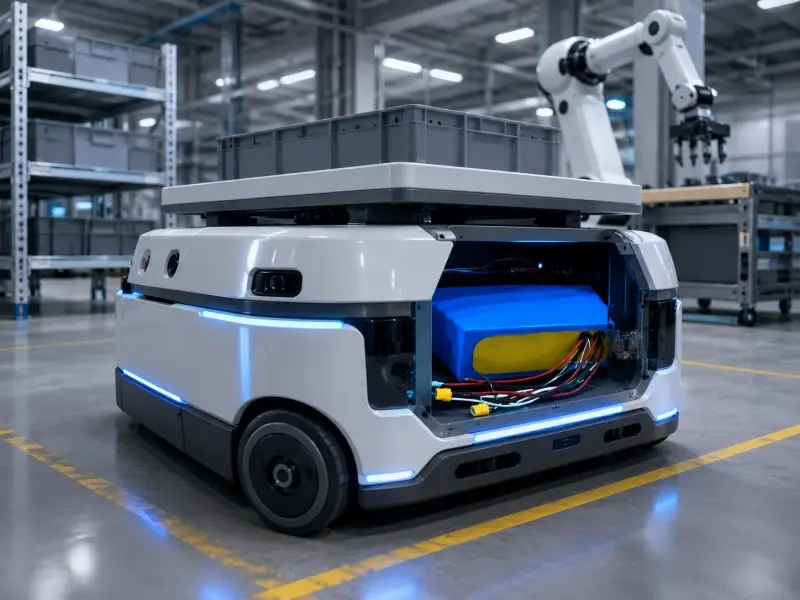
As robots move into warehouses, factories, hospitals, hotels, shopping centers, and inspection sites, their batteries become a central part of the system rather than a simple power source. A robot battery must support predictable runtime, stable output, safe charging, reliable communication, and mechanical integration within limited space.
A custom 38.4V 30Ah LiFePO4 battery module with a wireless charging port is designed around these practical needs. With approximately 1.15 kWh of nominal energy, it can power mobile robots, AGVs, AMRs, service robots, inspection platforms, and cleaning robots that require repeated charging and dependable daily operation.
Why 38.4V LiFePO4 Is Suitable for Robots
A nominal voltage of 38.4V is typically created by connecting twelve LiFePO4 cells in series. This configuration can suit robotic platforms built around a 36V electrical architecture while providing the stability and long service life associated with lithium iron phosphate chemistry.
LiFePO4 cells are widely used in mobile equipment because they offer a relatively flat discharge curve, good thermal stability, and reliable performance during frequent charge and discharge cycles. For a robot, that means motors, controllers, sensors, communication units, and onboard computers can receive more consistent power throughout the operating cycle.
The 30Ah capacity balances runtime, installation size, and weight. Actual operating time still depends on average current, peak load, payload, travel speed, terrain, accessory power, and charging strategy. Battery selection should therefore begin with real operating data rather than capacity alone.
Wireless Charging Supports Autonomous Operation
One of the most useful features of this module is its wireless charging interface. When paired with a compatible docking station, the robot can return to a charging point and recharge automatically without an operator connecting a cable.
This is valuable when robots work across multiple shifts or in locations where manual access is inconvenient. Warehouse AMRs can recharge between assignments, cleaning robots can dock during low-traffic periods, and inspection robots can recover energy after completing a route.
Wireless charging also reduces repeated wear on physical connectors. Successful integration, however, requires correct alignment, coordinated communication, controlled charging current, and suitable thermal management. Engineers should confirm charging power, docking tolerance, communication logic, cooling conditions, standby consumption, and the robot’s response if charging is interrupted.
Smart BMS Protection and Communication
A battery management system is essential in a custom robot battery module. It monitors operating conditions and helps prevent situations that could damage the cells or interrupt the robot.
Typical functions may include overcharge, over-discharge, overcurrent, short-circuit, and temperature protection, together with cell balancing. The exact protection limits should match the selected cells, discharge current, charger, and working environment.
For intelligent equipment, the BMS can also support CAN, RS485, RS232, UART, or a customized communication protocol. This allows the robot controller to read pack voltage, current, temperature, remaining capacity, state of charge, cycle information, and fault status.
Accurate battery data improves route planning and charging decisions. Instead of stopping unexpectedly, the robot can return to its charging station at a defined energy level and report abnormal conditions before they create downtime.
Custom Mechanical Design Is Equally Important
Robotic platforms often have strict internal space limits. A standard battery may provide the correct voltage and capacity but still fail to fit or connect properly.
The 38.4V 30Ah LiFePO4 battery module can be customized in dimensions, enclosure material, mounting points, cable direction, connector type, fuse arrangement, switch position, communication port, and wireless charging interface. The housing may also be adapted for vibration resistance, heat dissipation, dust protection, and easier maintenance.
Battery placement should consider the robot’s center of gravity. Installing a heavy module too high or too far from the intended position may affect stability, turning behavior, or traction. Mounting strength also matters because mobile robots experience repeated acceleration, braking, vibration, and occasional impact.
Engineers should also decide whether the pack will remain fixed inside the robot or be removable for service. Even with wireless charging, a manual charging or diagnostic connection can still be useful during testing and maintenance.
Typical Application Areas
This battery module can be adapted for many robotic platforms. In warehouses and factories, it can power AGVs and AMRs used for material transport, line-side delivery, and inventory movement. In commercial buildings, it can support cleaning robots, delivery robots, reception robots, and security patrol units.
Industrial inspection robots may use the battery to operate cameras, sensors, lighting, wireless communication, and drive motors during scheduled patrols. Similar solutions can also be developed for agricultural robots, hospital logistics robots, educational platforms, and specialized outdoor machines.
Each application has different priorities. A cleaning robot may need long runtime and frequent opportunity charging, while an inspection robot may require a rugged enclosure or better low-temperature performance. A warehouse AMR may prioritize accurate state-of-charge reporting, fast docking, and reliable communication with the fleet management system.
Information Required Before Customization
To develop the correct battery, the supplier should receive the robot’s nominal voltage, maximum charging voltage, average current, continuous current, peak current, required runtime, available space, connector details, communication protocol, operating temperature, and charging method.
Wireless charging projects should also include the charging station specification, required charging power, expected docking accuracy, and control sequence between the robot and charger. Drawings, photos, or a prototype enclosure can help reduce revisions and shorten development time.
Conclusion
A custom 38.4V 30Ah LiFePO4 battery module with a wireless charging port provides more than stored energy. It becomes part of the robot’s power, charging, communication, and control system.
By combining LiFePO4 chemistry, smart BMS protection, automatic docking support, and application-specific mechanical design, the module can improve runtime, reduce manual charging work, and support reliable autonomous operation. The best result comes from matching every electrical and mechanical detail to the real robot rather than choosing a battery only by voltage and capacity.
Talk to the Manufacturer
Resources & Insights
High Capacity Lithium Battery for Wearables: High-Voltage LiPo Cell Design
2026-10-19
Cylindrical Battery Packs for Laptops: 2S vs 3S vs 4S Battery Design
2026-10-19
Stage Lighting Battery Pack: Prevent Voltage Drop & LED Flicker
2026-10-19

Best Rechargeable Batteries for Smart Devices: Performance, Safety, and Selection Guide
2026-10-19


