


 Home /
 24V 36V 48V 52V 60V 72V 40Ah 50Ah LiFePO4 Rechargeable Battery Pack for RVs, AGVs, Golf Carts, and Energy Storage Systems


Table of Contents
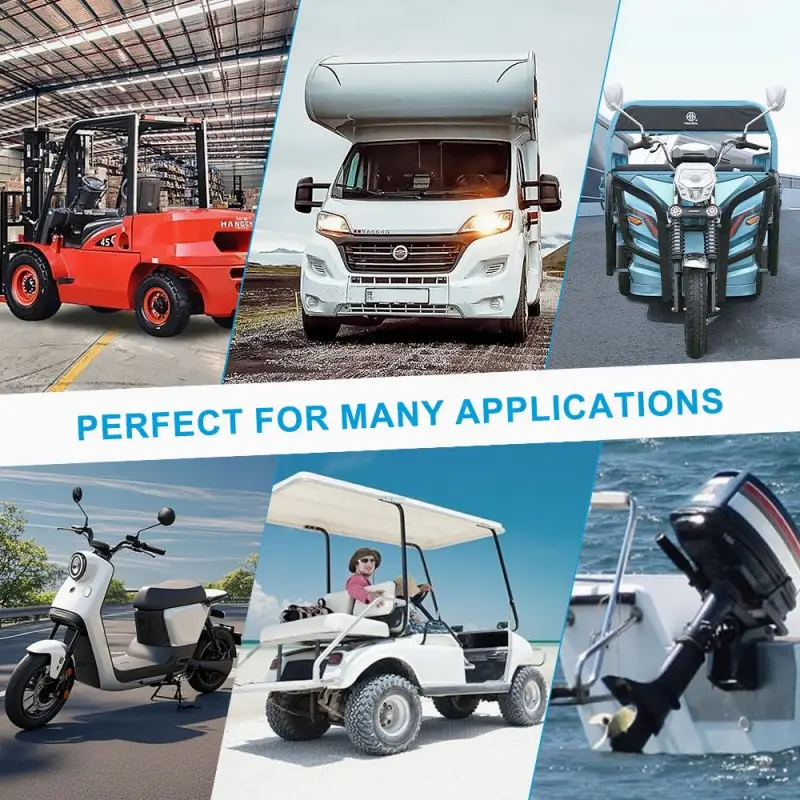
Choosing the right battery pack is not only about matching a voltage label. For RVs, automated guided vehicles, golf carts, mobile robots, and small energy storage systems, the battery must also deliver stable output, sufficient runtime, reliable protection, and a design that fits the available installation space.
A configurable LiFePO4 rechargeable battery pack available in 24V, 36V, 48V, 52V, 60V, and 72V versions with 40Ah or 50Ah capacity gives equipment manufacturers and system integrators greater flexibility. The battery can be adapted to different motors, controllers, chargers, communication requirements, and operating environments.
Why LiFePO4 Is Well Suited to Demanding Applications
Lithium iron phosphate, commonly called LiFePO4, is widely selected for applications that need dependable daily charging and discharging. Its chemistry is known for good thermal stability, consistent voltage output, and long service life when the pack is properly designed and operated.
Compared with traditional lead-acid batteries, a LiFePO4 pack can reduce weight while providing more usable energy. It also requires less routine maintenance and maintains a more stable output voltage during discharge. These advantages are useful in vehicles and machines where lower weight, predictable performance, and reduced downtime matter.
Battery chemistry, however, is only one part of the system. Cell consistency, electrical connections, thermal design, enclosure strength, wiring, and battery management all influence finished-pack performance.
Matching Voltage to the Equipment
The correct voltage depends on the motor, inverter, controller, charger, and overall electrical architecture.
A 24V battery pack may suit compact service vehicles, smaller robots, auxiliary RV systems, and light-duty equipment. A 36V or 48V pack is often considered for golf carts, AGVs, warehouse vehicles, and medium-power mobile platforms. Systems requiring higher power or lower operating current may use 52V, 60V, or 72V configurations.
A higher voltage does not automatically mean a better battery. It must match the equipment’s rated input and operating range. Before customization, the supplier should confirm nominal voltage, charging voltage, continuous current, peak current, connector type, and communication method.
Choosing Between 40Ah and 50Ah Capacity
Battery capacity mainly affects operating time between charges. A 40Ah option may be enough for moderate energy demand, limited installation space, or shorter shifts. A 50Ah version provides additional runtime for equipment that travels farther, carries heavier loads, or works for longer periods.
Capacity should not be selected by runtime alone. An AGV may have repeated acceleration, lifting, stopping, and charging cycles. A golf cart may face hills, passenger loads, and changing temperatures. An RV battery may support lights, refrigeration, pumps, and communication devices for many hours.
The better approach is to calculate energy demand from real operating data and allow a reasonable reserve instead of choosing the smallest possible battery.
Built-In BMS Protection
A battery management system is essential for controlling and protecting a rechargeable lithium battery pack. Depending on the project, the BMS may monitor cell voltage, pack voltage, current, and temperature.
Typical functions can include overcharge, over-discharge, overcurrent, short-circuit, and abnormal-temperature protection. Cell balancing can also help keep cells operating at a more consistent state of charge.
For intelligent equipment, the pack can support communication options such as CAN, RS485, RS232, or other interfaces when required. This allows the vehicle or energy system to read battery status, report faults, estimate remaining power, and coordinate charging or shutdown functions.
Applications Across Mobile and Stationary Equipment
For RVs, LiFePO4 battery packs can support lighting, appliances, control systems, pumps, and auxiliary power. Their lower weight and stable discharge characteristics make them practical for mobile living and off-grid use.
In AGVs and AMRs, the battery must support predictable operation, repeated charging, and communication with the vehicle controller. Compact dimensions, secure mounting, durable connectors, and suitable discharge current are often as important as capacity.
Golf carts and low-speed electric vehicles need batteries that can handle acceleration, slopes, passenger loads, and frequent use. A properly matched 48V, 60V, or 72V pack can offer a practical upgrade path when the controller and charger are compatible.
For energy storage, these packs can be used in backup power, solar storage, mobile workstations, and small commercial systems. Enclosure design, installation method, parallel connection, and communication requirements should be confirmed during system planning.
Customization for OEM and ODM Projects
Industrial and vehicle batteries often require more than a standard voltage and capacity. The dimensions must fit the equipment, while terminal position, cable length, connector, fuse, switch, display, mounting points, and enclosure must match the installation.
OEM and ODM options may include charging specifications, discharge current, communication protocol, waterproofing, shock resistance, low-temperature heating, branding, labeling, and packaging.
A useful battery inquiry should include equipment type, working voltage, required runtime, continuous and peak current, installation dimensions, charger information, connector photos, operating temperature, communication requirements, and expected order quantity. Providing these details early can reduce revisions and shorten development time.
Quality Control From Cells to Finished Pack
A reliable battery pack depends on controlled incoming materials and consistent production. Cell matching, insulation, welding quality, wire routing, connector assembly, BMS installation, enclosure sealing, and final testing all need clear inspection standards.
Before shipment, the pack should be checked for voltage, capacity, charge and discharge behavior, protection functions, insulation, appearance, and connection reliability. Application-specific testing may also be required depending on the equipment and destination market.
Conclusion
A 24V to 72V, 40Ah or 50Ah LiFePO4 rechargeable battery pack can serve RV, AGV, golf cart, robotic, mobility, and energy storage applications. The best result comes from matching the battery to the actual load, installation space, operating environment, and communication needs.
Rather than selecting a battery by voltage and capacity alone, buyers should treat it as part of the complete power system. Careful specification, professional customization, and strict quality control help create a safer, more reliable, and longer-lasting energy solution.
Talk to the Manufacturer
Resources & Insights

High Capacity Lithium Battery for Wearables: High-Voltage LiPo Cell Design
2026-10-19
Cylindrical Battery Packs for Laptops: 2S vs 3S vs 4S Battery Design
2026-10-19

Stage Lighting Battery Pack: Prevent Voltage Drop & LED Flicker
2026-10-19

Best Rechargeable Batteries for Smart Devices: Performance, Safety, and Selection Guide
2026-10-19


