


 Home /
Irregular Shaped Lithium Battery: Design Options and OEM Selection Guide


Table of Contents
- What Is an Irregular Shaped Lithium Battery?
- When Does an Irregular Battery Shape Make Sense?
- Common Irregular Battery Layouts
- Why Outer Dimensions Alone Cannot Determine Capacity
- Important Design Requirements
- Custom Cell or Custom Pack: Which Should You Evaluate?
- What to Validate Before Mass Production
- How to Prepare an Irregular Battery RFQ
- Cost, MOQ, and Development Schedule
- Evaluate Your Custom Battery Requirements With Gloflux
-
Frequently Asked Questions
- What is an irregular shaped lithium battery?
- Can a lithium battery be made in any shape?
- Does an irregular shape always provide more capacity?
- Can I cut or bend a standard pouch cell to fit?
- Is an irregular shaped battery more expensive?
- Can an irregular battery use a standard charger?
- Can Gloflux assess my battery drawing?
- Start With Your Device Requirements
An irregular shaped lithium battery can help product developers use an installation space that a standard rectangular or cylindrical battery cannot fit efficiently.
The opportunity is especially relevant when circuit boards, sensors, connectors, or structural features divide the available space. A battery with a tailored outline may fit around these components and give engineers another way to meet a runtime target within a fixed enclosure.
However, a more complex shape is not automatically a better battery. The design must balance usable capacity, electrical performance, mechanical integration, development cost, and production requirements.
This guide explains how to evaluate an irregular shaped lithium battery and prepare a practical specification for an OEM project.
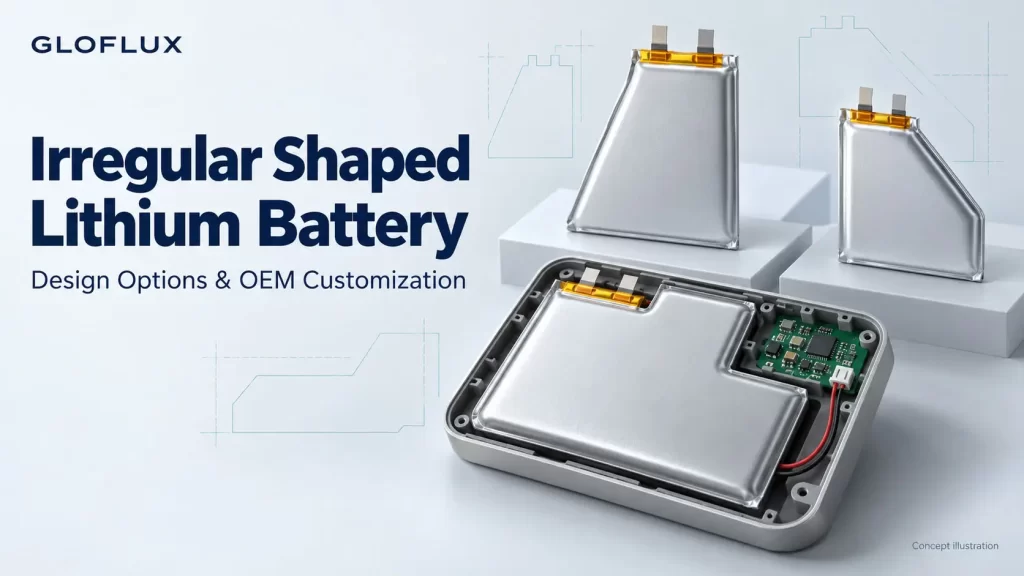
What Is an Irregular Shaped Lithium Battery?
An irregular shaped lithium battery has a nonstandard outline or profile designed for a particular installation space.
In compact rechargeable electronics, this often involves a lithium polymer pouch cell. Commercial special-shaped battery offerings include L-shaped, U-shaped, curved, D-shaped, trapezoidal, and other irregular formats. Availability depends on the manufacturer and proposed design. Special-shaped battery formats.
The term can also describe a complete battery pack whose cells and supporting components form an irregular assembly.
Before requesting a quotation, distinguish between:
- A custom-shaped cell: The electrochemical cell itself has a particular geometry.
- A custom-shaped battery pack: Cells, protection electronics, wiring, and packaging form an assembly that fits the product.
A supplier may support one approach, both approaches, or only certain geometries.
When Does an Irregular Battery Shape Make Sense?
The Enclosure Contains Fixed Obstructions
A circuit board, mounting boss, sensor, or connector may prevent a standard battery from occupying the full compartment.
An irregular design is worth evaluating when useful space remains around that obstruction and the product layout cannot easily change.
The Product Needs More Runtime Without a Larger Housing
If a shaped battery can use space left empty by a standard cell, it may provide an opportunity to increase installed battery capacity.
The comparison should use the same enclosure boundaries and include the complete battery assembly. Ask the supplier to assess achievable energy and runtime rather than assuming a capacity increase from the outline alone.
The Industrial Design Has Unusual Dimensions
A tapered handle, angled housing, or curved wearable enclosure may create a compartment that is difficult to describe using length, width, and thickness alone.
Provide the actual geometry and let the battery manufacturer evaluate feasible options. Avoid committing to a specific shape before the electrical requirements have been reviewed.
Several Design Requirements Must Be Balanced Together
Sometimes the battery must fit a restricted space while also meeting a demanding load profile or a particular connection layout.
A useful engineering review considers these requirements together. Solving the outline first and leaving protection, wiring, or charging until later can create avoidable revisions.
Common Irregular Battery Layouts
The following examples illustrate how different footprints may relate to product layouts. They are starting points for evaluation, not guarantees of manufacturability.
| Battery layout | Installation scenario to evaluate | Key design question |
|---|---|---|
| L-shaped | A component occupies one corner | Can the remaining two adjoining areas support a practical cell design? |
| U-shaped | A central component leaves space on both sides | Are the arms, opening, and connecting section feasible? |
| D-shaped | A compartment combines a straight edge with a rounded boundary | Can the cell fit while preserving required clearances? |
| Trapezoidal | An enclosure narrows toward one end | Does the tapered outline offer enough benefit over a rectangular cell? |
| Curved | The housing follows a defined arc | What radius and mounting conditions can the cell accommodate? |
| Other irregular outline | Several components constrain the available space | Can the outline be simplified without compromising the product? |
For more complex designs, manufacturers describe the need to consider electrode geometry, tab placement, current distribution, and thermal behavior together. Custom battery geometry considerations.
Why Outer Dimensions Alone Cannot Determine Capacity
A drawing showing the maximum battery envelope is essential, but it does not establish how much capacity the battery will provide.
The manufacturer must translate that envelope into a cell structure and finished assembly. Seals, tabs, protection electronics, insulation, and connection space all need consideration.
Ask the supplier for three separate outputs:
- The proposed finished battery drawing.
- The achievable capacity and electrical limits under stated conditions.
- The assumptions or design changes needed to achieve those specifications.
Do not estimate capacity simply by applying the percentage increase in footprint area to an existing battery model.
Illustrative Design Scenario
Imagine a compact instrument with space beside and below a fixed circuit board.
A standard rectangular cell fits below the board. An irregular cell could potentially extend into the side space, but doing so may require additional tooling and a different terminal arrangement.
A useful comparison would assess:
| Comparison point | Existing rectangular option | Proposed irregular option |
|---|---|---|
| Finished assembly fit | Confirm against the enclosure | Confirm against the enclosure |
| Usable energy | Supplier specification and testing | Supplier specification and testing |
| Runtime | Device-level validation | Device-level validation |
| Development cost | Quote required | Quote required |
| Sample schedule | Confirm availability | Confirm engineering and tooling stages |
| Production plan | Confirm repeat supply | Confirm repeat supply and change control |
The decision should follow those results, rather than the visual appeal of the custom outline.
Important Design Requirements
Define the Full Installation Envelope
Provide a dimensioned drawing or CAD model showing:
- Maximum external dimensions.
- Cutouts and restricted areas.
- Corner and curvature requirements.
- Maximum permitted thickness.
- Nearby mounting features.
- Tab and wire exit preferences.
- Connector location.
- Space for protection electronics.
Identify dimensions that are fixed and those that can change. This gives the manufacturer room to recommend a practical adjustment.
Account for Mechanical Integration
Review the finished battery in its enclosure, including support, retention, assembly access, and separation from nearby components.
Pouch cells require suitable handling and installation conditions, including the manufacturer’s specified allowance for dimensional changes. A close visual fit is not sufficient evidence that an enclosure is appropriate. Jauch lithium polymer battery technical guide.
Specify the Real Electrical Load
Share the product’s operating profile, including standby demand, typical current, continuous maximum current, and peak-current duration.
For a device that operates intermittently, explain the usage cycle. A runtime target is more useful when the manufacturer understands what the product does during that time.
Match the Charging System to the Selected Cell
The battery’s shape does not determine its charging voltage, current, or temperature limits.
Use the approved cell specification to define charging requirements and review compatibility with the device’s charging electronics. Jauch lithium polymer battery technical guide.
Review Heat Sources Near the Battery
Identify nearby components that generate heat during use or charging.
Ask the manufacturer to define appropriate evaluation conditions for the complete device, including simultaneous activities such as charging while operating a display, radio, or motor.
Agree on Protection and Monitoring
Clarify which protection functions are included in the battery assembly and which are provided by the device.
Include the protection circuit, temperature sensor where required, wiring, and connector in the mechanical review. These items should be part of the proposed assembly, rather than additions after the cell outline is approved.
Custom Cell or Custom Pack: Which Should You Evaluate?
A single irregular cell is one possible solution. A pack using existing cells may offer another route.
| Consideration | Custom irregular cell | Pack using existing cells |
|---|---|---|
| Geometry | Cell outline developed for the compartment | Assembly arranged around available cell formats |
| Development | May require cell-specific tooling and validation | Requires pack design and integration |
| Space allocation | Review cell seals, tabs, and supporting components | Review cells, gaps, connections, and supporting components |
| Electrical design | Confirm the proposed cell specification | Confirm configuration, compatibility, and protection |
| Commercial terms | Confirm tooling, samples, and MOQ | Confirm component availability, assembly cost, and MOQ |
Request both approaches where they are feasible. The preferred option should satisfy the complete product specification and production plan.
What to Validate Before Mass Production
A prototype should answer more than whether the battery fits.
Agree on acceptance criteria covering:
- Mechanical fit: Finished dimensions, connector access, and installation.
- Runtime: Performance under a representative usage cycle.
- Load response: Operation during expected peak demands.
- Charging: Compatibility with the intended charging system.
- Temperature: Behavior under agreed operating conditions.
- Protection: Required functions and their validation.
- Documentation: Alignment between model numbers, drawings, and relevant reports.
Record sample revisions and update the approved specification after design changes. This creates a clear reference for production.
How to Prepare an Irregular Battery RFQ
| RFQ item | Information to provide |
|---|---|
| Product | Device type and intended use |
| Mechanical drawing | Available space, cutouts, curvature, and thickness |
| Design flexibility | Fixed constraints and dimensions open to adjustment |
| Battery architecture | Custom cell, custom pack, or open to either |
| Voltage | Operating range and charging architecture |
| Capacity or runtime | Minimum capacity or target operating time |
| Load profile | Typical, maximum continuous, and peak current |
| Environment | Operating and storage conditions |
| Connections | Connector, polarity, wire length, and exit direction |
| Protection | Required protection and temperature monitoring |
| Documentation | Target markets and requested supporting reports |
| Quantity | Prototype, pilot, and annual production forecast |
| Schedule | Sample deadline and planned production date |
Where possible, share a drawing of the surrounding components as well as the battery compartment.
Cost, MOQ, and Development Schedule
A new irregular cell can involve a different development commitment from modifying an existing battery assembly.
Ask the supplier to separate engineering, tooling, samples, testing, and production pricing. Confirm how design revisions affect the quotation and schedule.
Existing cells, standard connectors, and established protection components can make smaller initial orders more practical. Gloflux discusses these considerations in its guide to low-MOQ custom battery projects.
There is no universal MOQ or lead time for an irregular shaped lithium battery. Request project-specific milestones for feasibility review, drawing approval, prototypes, validation, and production.
Evaluate Your Custom Battery Requirements With Gloflux
Gloflux provides custom LiPo and battery pack services covering dimensions, voltage, capacity, protection electronics, wiring, connectors, and enclosure design. Its published process includes requirements assessment, cell sourcing, engineering, prototype testing, and mass production. Gloflux custom battery solutions.
For an irregular installation space, start with a drawing-based assessment. The review should identify whether an existing cell, a custom assembly, or a specially shaped cell is a practical candidate.
Specific irregular cell geometries, achievable specifications, tooling, and production terms require confirmation for each project.
Frequently Asked Questions
What is an irregular shaped lithium battery?
It is a lithium battery with a nonstandard outline or profile intended to fit a particular product. The term may refer to an individual cell or a complete battery pack.
Can a lithium battery be made in any shape?
Not every proposed outline is practical. The manufacturer must review geometry, materials, electrical requirements, and production constraints. Submit the actual installation drawing for assessment.
Does an irregular shape always provide more capacity?
No. It may use a constrained compartment more effectively, but capacity depends on the proposed design. Compare the usable energy and runtime of the complete solutions.
Can I cut or bend a standard pouch cell to fit?
No. A standard cell should not be cut or reshaped. A soft pouch does not mean that the battery is designed for bending. Use a cell manufactured and validated for the intended geometry. Jauch lithium polymer battery technical guide.
Is an irregular shaped battery more expensive?
It can introduce engineering, tooling, and validation costs. Request a comparison with an existing-cell solution and assess total project cost alongside production pricing.
Can an irregular battery use a standard charger?
Compatibility depends on the selected cell’s specifications and the charger’s behavior, not the outline. Have the supplier review the intended charging system.
Can Gloflux assess my battery drawing?
Gloflux offers custom battery engineering and prototype services. Submit the available space, electrical requirements, and expected quantity to discuss feasible options.
Start With Your Device Requirements
A useful irregular shaped lithium battery proposal begins with the installation space and the performance the product must deliver.
Send Gloflux your enclosure drawing, voltage requirements, runtime target, load profile, and expected order quantity. These details provide the basis for evaluating available options and planning prototype development.
Talk to the Manufacturer
Resources & Insights

High Capacity Lithium Battery for Wearables: High-Voltage LiPo Cell Design
2026-10-19
Cylindrical Battery Packs for Laptops: 2S vs 3S vs 4S Battery Design
2026-10-19

Stage Lighting Battery Pack: Prevent Voltage Drop & LED Flicker
2026-10-19

Best Rechargeable Batteries for Smart Devices: Performance, Safety, and Selection Guide
2026-10-19


