


 Home /
Custom Size Lithium Battery: How to Specify the Right Fit for Your Device


Table of Contents
- What Is a Custom Size Lithium Battery?
- Custom Size vs. Custom Shape: What Is the Difference?
- Start With the Installation Space, Not Just the Cell Size
- How to Specify Custom Lithium Battery Dimensions
- Balancing Battery Size, Capacity, and Runtime
- Which Battery Approach Should You Evaluate First?
- What to Confirm Before Ordering Samples
- Custom Size Lithium Battery RFQ Checklist
- From Prototype to Production
- MOQ, Cost, and Lead Time
- Custom Battery Development With Gloflux
-
Frequently Asked Questions
- Can lithium batteries be made in custom sizes?
- What dimensions should I send to the manufacturer?
- Does a smaller battery always have less capacity?
- Can a thinner battery keep the same capacity?
- Do I need a new cell if I only want a different connector?
- Is a custom size battery compatible with my charger?
- Can Gloflux provide samples before production?
- Request a Custom Size Battery Assessment
A custom size lithium battery helps product developers match a battery to the available installation space and electrical requirements of a device.
The challenge is rarely just finding the right length and width. A battery must also fit within the permitted thickness, accommodate protection electronics and connections, and deliver the required runtime under actual operating conditions.
Before developing a new cell, it is worth comparing existing battery sizes, customized assemblies, and new cell dimensions. This guide explains how to make that comparison and prepare a useful specification for your manufacturer.
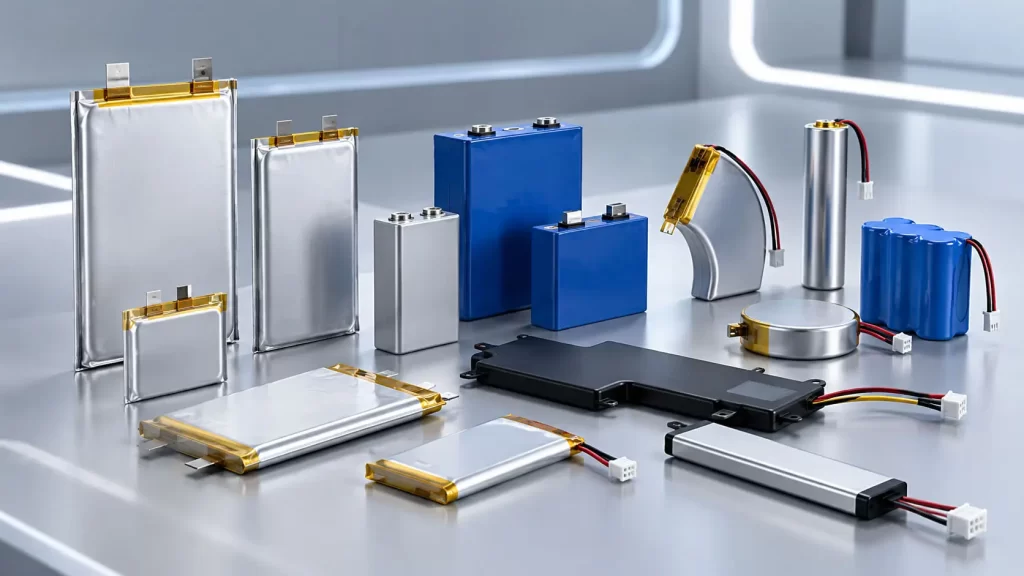
What Is a Custom Size Lithium Battery?
A custom size lithium battery is a cell or battery assembly developed or selected to meet particular dimensional requirements.
The term can describe several different approaches:
| Approach | What changes | When to evaluate it |
|---|---|---|
| Existing cell with customized connections | Wiring, connector, insulation, or protection arrangement | The cell fits, but the finished assembly needs adaptation |
| Custom size LiPo cell | Cell length, width, or thickness | Available cell dimensions cannot meet the product requirements |
| Custom battery pack | Cell arrangement, electronics, packaging, or enclosure | The product needs a complete assembly within a defined space |
| Custom shaped cell | Outline or curvature, as well as dimensions | The compartment has an irregular boundary |
Gloflux offers LiPo dimension customization and battery pack development, including wiring, connectors, protection electronics, and enclosures. The feasible dimensions and specifications depend on the proposed project. Gloflux custom battery solutions.
Custom Size vs. Custom Shape: What Is the Difference?
Size customization changes dimensions such as length, width, and thickness. A rectangular battery can remain rectangular while becoming longer, narrower, or thinner.
Shape customization changes the outline or profile—for example, to fit around an obstruction or follow a curved enclosure.
Start by identifying the actual constraint. If a rectangular compartment simply needs a different thickness, a complex shaped cell may be unnecessary.
Start With the Installation Space, Not Just the Cell Size
A common specification problem is treating the battery compartment dimensions as the requested cell dimensions.
The complete battery may include components beyond the bare cell:
- Pouch seals and terminal tabs.
- Protection electronics.
- Temperature sensing components.
- Insulation and packaging.
- Wires and connectors.
- Mounting or retention materials.
Ask for a drawing of the finished battery assembly and compare it with the available compartment.
Pouch-cell integration also requires suitable support and allowance for dimensional changes. Follow the cell manufacturer’s installation guidance rather than assuming that a nominally matching battery can be placed in a tight enclosure. Jauch lithium polymer battery technical guide.
Illustrative Sizing Example
Suppose a device has a battery compartment measuring 50 × 30 × 6 mm.
Those numbers describe the available space—not an automatically acceptable battery size. The manufacturer still needs to account for assembly tolerances, packaging, protection components, routing, and installation requirements.
Provide the compartment drawing and ask the supplier to propose the maximum finished battery dimensions. Any clearance values should come from the approved design, not a generic rule.
How to Specify Custom Lithium Battery Dimensions
1. Identify the Measurement Direction
State which dimension is length, width, and thickness. Include units and mark the terminal side on the drawing.
Do not rely on a model code alone to communicate the required dimensions. Use an approved mechanical drawing as the reference.
2. Separate Nominal and Maximum Dimensions
A nominal measurement is not necessarily the largest dimension a production unit may have.
Ask the supplier to define dimensional tolerances and maximum finished dimensions under agreed measurement conditions. Confirm whether the drawing covers the bare cell or the protected battery assembly.
3. Show Restricted Areas
Mark nearby circuit boards, connectors, screws, ribs, moving parts, and other features that limit placement.
Include the wire route and connector access. A cell may fit while its connector remains inaccessible during assembly.
4. Identify Flexible Dimensions
Tell the manufacturer which constraints are fixed and which can change.
For example, thickness may be fixed while a small increase in length is acceptable. That information allows the supplier to compare more feasible options.
5. Request an Assembly Review
Review how the battery will be inserted, retained, connected, and serviced where applicable.
A battery that fits in a CAD model may still create assembly difficulties if the installation sequence or cable routing has not been considered.
Balancing Battery Size, Capacity, and Runtime
Dimensions and capacity should be evaluated together.
Instead of asking only for the highest mAh rating that fits, provide the manufacturer with the device’s operating requirements:
- Target runtime.
- Typical operating current.
- Standby demand.
- Maximum continuous current.
- Peak-current duration and frequency.
- Operating temperature range.
- Charging requirements.
These inputs allow the supplier to assess the proposed battery against the application.
Compare Usable Energy, Not Only mAh
When comparing batteries with different nominal voltages, capacity in mAh alone does not describe their nominal energy.
A basic comparison is:
Nominal energy (Wh) = Nominal voltage (V) × Capacity (Ah)
For example, a hypothetical 3.7 V, 1,000 mAh battery has a nominal energy of 3.7 Wh. This is not a guaranteed runtime figure: actual usable energy depends on operating conditions, conversion losses, and the device’s cutoff limits.
For a meaningful supplier comparison, request performance under consistent test conditions and validate runtime in the intended product.
Do Not Assume Capacity Scales Directly With Dimensions
Reducing thickness or changing the footprint does not establish a predictable percentage change in capacity.
Ask the manufacturer to propose achievable specifications for each candidate size. Compare the resulting capacity, electrical limits, cost, and development requirements together.
Which Battery Approach Should You Evaluate First?
Existing Cell With a Customized Assembly
This is a useful starting point when an available cell already fits the compartment.
Changes to wiring, connectors, protection, or packaging may be sufficient. Gloflux identifies existing cells and established components as factors that can make smaller initial orders more practical. Gloflux low-MOQ battery guidance.
Custom Size LiPo Cell
Evaluate a new cell dimension when existing options cannot satisfy the installation and performance requirements.
Request confirmation of feasible dimensions, capacity, current limits, tooling, sample quantities, and validation requirements. Do not treat arbitrary combinations of length, width, thickness, and capacity as automatically achievable.
Custom Pack Using Standard Cells
For a multi-cell product, a different arrangement of existing cells may provide a suitable assembly size.
The review should cover electrical configuration, protection, interconnections, packaging, and the final enclosure. Customizing a pack’s size does not necessarily involve changing the dimensions of its individual cells.
What to Confirm Before Ordering Samples
Ask the supplier to provide a proposal covering four areas.
| Area | Information to confirm |
|---|---|
| Mechanical | Finished dimensions, tolerances, connection locations, and installation requirements |
| Electrical | Voltage range, minimum capacity, current limits, charging conditions, and protection |
| Commercial | Engineering charges, tooling, sample costs, MOQ, and production pricing |
| Validation | Sample acceptance criteria, test conditions, and required supporting documentation |
Resolve important assumptions before approving the design. A quotation should make clear which specifications are confirmed and which remain subject to prototype evaluation.
Custom Size Lithium Battery RFQ Checklist
A complete RFQ helps the manufacturer evaluate your project and makes competing proposals easier to compare.
| Requirement | What to provide |
|---|---|
| Application | Product type and intended use |
| Installation drawing | Maximum available dimensions and restricted areas |
| Dimensional priorities | Fixed constraints and dimensions open to adjustment |
| Battery architecture | Single cell, multi-cell pack, or open to recommendations |
| Voltage | Device operating range and charging architecture |
| Runtime | Target runtime and representative usage pattern |
| Capacity | Minimum capacity, if already established |
| Current | Typical, maximum continuous, and peak demand |
| Environment | Operating and storage conditions |
| Connections | Connector, pinout, wire length, and exit direction |
| Protection | Required protection and monitoring functions |
| Documentation | Target markets and requested supporting reports |
| Quantity | Prototype, pilot, and expected annual volume |
| Schedule | Sample deadline and planned production date |
If the design is still developing, identify open questions. A clear distinction between requirements and preferences helps the supplier recommend alternatives.
From Prototype to Production
An effective development plan should include clear approval points.
- Requirements review: Confirm the installation space and electrical targets.
- Option comparison: Evaluate existing cells, assembly changes, and custom dimensions.
- Drawing approval: Agree on the finished battery envelope and specification.
- Prototype testing: Check fit, runtime, charging, and expected operating loads.
- Design release: Finalize drawings, components, documentation, and acceptance criteria.
- Production validation: Confirm assembly consistency before increasing volume.
Keep the approved specification and drawing revision linked to the samples and production orders. Agree on how future changes to cells or components will be reviewed.
MOQ, Cost, and Lead Time
There is no universal MOQ or delivery schedule for a custom size lithium battery.
An existing cell with a different connector involves different development work from a new cell size or molded pack enclosure. Ask for separate estimates for engineering, tooling, samples, testing, and production.
Compare complete project costs rather than unit price alone. Also confirm whether quoted lead times begin at the inquiry, drawing approval, material availability, or another milestone.
Custom Battery Development With Gloflux
Gloflux’s published customization process includes requirements assessment, cell sourcing, engineering design, prototype testing, mass production, and after-sales service. Its options cover battery dimensions, voltage, capacity, protection, wiring, connectors, and packaging. Explore Gloflux’s customization process.
For a custom size requirement, begin with the available installation space and the performance your device needs. The review can then determine whether an existing cell, a modified assembly, or a new cell dimension is appropriate.
Specific dimensions, capacity, tooling, quantities, and schedules require project-level confirmation.
Frequently Asked Questions
Can lithium batteries be made in custom sizes?
Custom sizes are possible for suitable battery designs, but feasibility depends on the cell platform, electrical requirements, production methods, and order scope. Submit the required dimensions for assessment.
What dimensions should I send to the manufacturer?
Send the maximum available installation envelope, restricted areas, connection locations, and a dimensioned drawing. Ask the manufacturer to propose the finished battery dimensions.
Does a smaller battery always have less capacity?
Size affects the design options, but batteries of different technologies and constructions should not be compared by dimensions alone. Request model-specific capacity and performance data.
Can a thinner battery keep the same capacity?
It may be possible by changing other dimensions or selecting a different design, but it is not guaranteed. Ask the supplier to compare feasible options within your fixed constraints.
Do I need a new cell if I only want a different connector?
Often, an existing cell can be used with a customized assembly. Confirm connector type, polarity, current requirements, wire routing, and protection compatibility.
Is a custom size battery compatible with my charger?
Size does not determine charging compatibility. The charger must match the selected battery’s electrical specifications and charging limits. Jauch lithium polymer battery technical guide.
Can Gloflux provide samples before production?
Gloflux states that it supports sample development and prototyping. The sample plan and schedule should be confirmed after reviewing the project requirements. Gloflux prototype services.
Request a Custom Size Battery Assessment
The right custom size lithium battery must fit the product and support the way it operates.
Send Gloflux your compartment drawing, voltage requirements, runtime target, load profile, and expected quantity. These details provide the basis for evaluating available options and planning prototype development.
Talk to the Manufacturer
Resources & Insights
High Capacity Lithium Battery for Wearables: High-Voltage LiPo Cell Design
2026-10-19
Cylindrical Battery Packs for Laptops: 2S vs 3S vs 4S Battery Design
2026-10-19
Stage Lighting Battery Pack: Prevent Voltage Drop & LED Flicker
2026-10-19

Best Rechargeable Batteries for Smart Devices: Performance, Safety, and Selection Guide
2026-10-19


