


 Home /
L-Shaped Lithium Battery: A Custom LiPo Design Guide for OEMs


Table of Contents
- What Is an L-Shaped Lithium Battery?
- Why Consider an L-Shaped LiPo Battery?
- Where Can L-Shaped Batteries Be Used?
- L-Shaped Battery vs. Rectangular Battery
- Key Design Requirements for an L-Shaped Lithium Battery
- What Affects the Cost of a Custom L-Shaped Battery?
- How to Prepare an L-Shaped Battery RFQ
- Evaluating Your Battery Project With Gloflux
-
Frequently Asked Questions
- Is an L-shaped lithium battery the same as an L-shaped LiPo battery?
- Does an L-shaped battery always provide more capacity?
- Can a standard LiPo battery be bent into an L shape?
- Can two rectangular cells form an L-shaped battery pack?
- What is the MOQ for an L-shaped lithium battery?
- How long does development take?
- Can Gloflux evaluate an L-shaped battery requirement?
- Discuss Your L-Shaped Battery Requirements
An L-shaped lithium battery can help product designers use an irregular battery compartment more effectively. When a circuit board, connector, or other component occupies one corner of a device, a conventional rectangular cell may leave usable space empty.
However, choosing an L-shaped battery involves more than matching an outline. Engineers must also consider capacity, electrical load, protection, assembly clearances, and production feasibility.
This guide explains what an L-shaped lithium battery is, when it may be useful, and what to prepare before requesting a custom solution.
What Is an L-Shaped Lithium Battery?
An L-shaped lithium battery has a footprint resembling the letter “L.” In compact electronics, the term often refers to a lithium polymer pouch cell manufactured with this geometry. Commercial L-shaped pouch cells are available in different dimensions, capacities, and voltage specifications. L-shaped pouch battery examples.
The term can also describe a battery assembly arranged in an L-shaped layout. These two approaches require different engineering decisions.
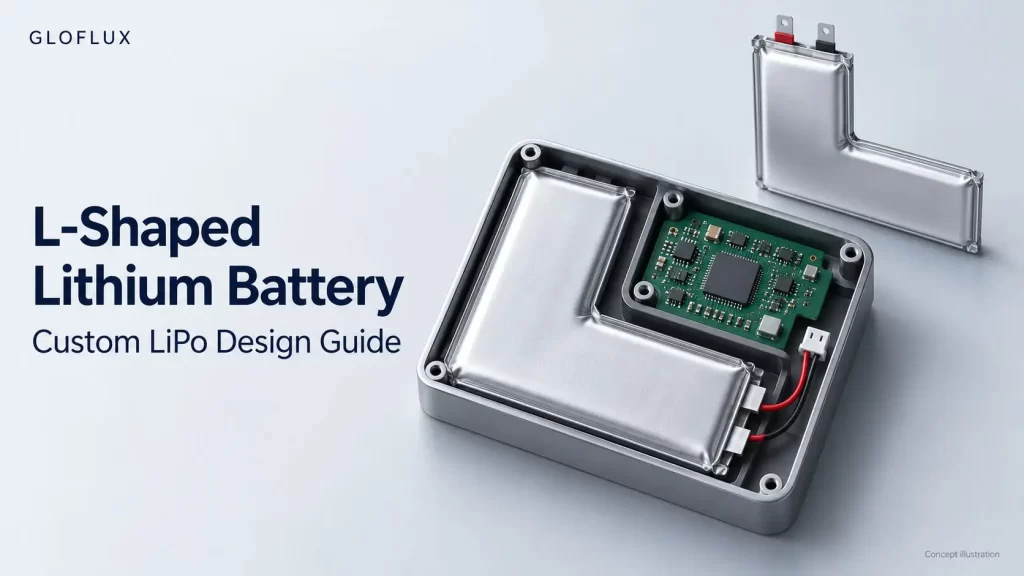
| Design approach | What it means | Main evaluation point |
|---|---|---|
| Single L-shaped cell | One cell is manufactured with an L-shaped outline | Cell geometry, tooling, electrical performance, and production feasibility |
| L-shaped battery pack | Multiple cells and supporting components form an L-shaped assembly | Cell arrangement, interconnections, protection, and finished dimensions |
When contacting a manufacturer, specify whether you need a single shaped cell or a complete pack that fits an L-shaped space.
Why Consider an L-Shaped LiPo Battery?
Use Space Around Fixed Components
An L-shaped cell may fit around a component that prevents installation of a larger rectangular battery. Manufacturers identify better use of irregular internal space as a reason for developing these designs. L-shaped battery design applications.
For example, consider a handheld device with a connector assembly occupying its upper-right corner. A rectangular battery might fit only below that assembly. An L-shaped design could potentially extend beside it as well.
Whether that extra area produces a worthwhile capacity increase requires a manufacturer’s assessment of the actual geometry.
Evaluate a Larger Battery Within the Same Enclosure
If a shaped cell can use previously empty space, it may allow more battery capacity without enlarging the product. This is a packaging opportunity, rather than an automatic improvement in cell chemistry or energy density.
The useful comparison is:
How much usable energy can each complete battery solution provide within the same permitted installation space?
Request proposals for both a rectangular option and an L-shaped option before committing to custom tooling.
Coordinate Battery and Product Design Earlier
An irregular battery requirement is easier to evaluate while the enclosure, circuit board, and connection locations can still be adjusted.
Early discussion gives both teams an opportunity to identify small layout changes that could simplify manufacturing or make an existing battery model suitable.
Where Can L-Shaped Batteries Be Used?
Published L-shaped battery applications include medical equipment, VR/AR glasses, and Bluetooth glasses. Suitability depends on the specific product layout and operating requirements. L-shaped battery application examples.
Other projects worth evaluating may include:
- Handheld electronics: Where a display, speaker, or connector occupies part of the battery compartment.
- Compact monitoring devices: Where the battery must share space with sensing electronics.
- Portable instruments: Where a fixed board layout leaves an irregular installation area.
- Custom consumer devices: Where enclosure geometry limits standard battery choices.
These are potential design scenarios, not confirmation that every device benefits from an L-shaped cell.
For a wearable project, review Gloflux’s smart wearable battery solutions alongside your mechanical requirements.
L-Shaped Battery vs. Rectangular Battery
The most suitable battery is the one that meets the product requirements with an acceptable development and supply plan.
| Consideration | L-shaped battery | Rectangular battery |
|---|---|---|
| Mechanical fit | May suit a compartment with a corner obstruction | Suits a clear rectangular compartment |
| Available models | Exact geometry may require customization | An existing model may be suitable |
| Capacity comparison | Requires evaluation of the usable shaped area | Requires evaluation of the available rectangular area |
| Development work | May involve new tooling and geometry validation | Can be simpler when using an approved existing cell |
| Commercial evaluation | Include engineering, tooling, and sample costs | Compare existing-cell pricing and assembly modifications |
| Preferred starting point | Investigate when enclosure constraints justify it | Evaluate first when the compartment permits it |
Ask the supplier to compare both approaches using the same load profile, runtime target, and installation boundaries.
Key Design Requirements for an L-Shaped Lithium Battery
1. Provide a Fully Dimensioned Drawing
Overall length and width do not fully define an L-shaped footprint.
Your drawing should identify:
- Overall length, width, and maximum thickness.
- Width of each arm.
- Dimensions of the cutout.
- Inner and outer corner requirements.
- Tab and wire exit locations.
- Space reserved for protection electronics.
- Restricted areas and mounting features.
Ask the supplier to identify achievable tolerances and any proposed changes to the outline.
2. Define the Complete Assembly Envelope
Review the dimensions of the finished battery, including seals, tabs, insulation, wires, connectors, and protection components.
Pouch-cell integration also requires appropriate mechanical support and allowance for dimensional changes. Obtain the manufacturer’s installation requirements rather than designing a tight enclosure around nominal cell dimensions alone. Jauch lithium polymer battery technical guide.
3. Specify Runtime and Electrical Load Together
A runtime target is more useful when accompanied by the device’s operating profile.
Tell the supplier how the product behaves during standby, normal operation, and peak demand. Include the duration and frequency of current pulses where applicable.
If capacity is already specified, ask the supplier to confirm whether it is achievable within the proposed geometry and under the required discharge conditions.
4. Confirm Charging Compatibility
The L-shaped outline does not determine the charging voltage or charging rate. These depend on the selected cell specification.
Match the charger to the approved cell’s voltage, current, and temperature limits. Do not infer charging compatibility from appearance or nominal voltage alone. Jauch lithium polymer battery technical guide.
5. Allocate Space for Protection and Connections
Discuss which protection functions belong inside the battery assembly and which are provided by the device.
Include the proposed protection circuit, temperature sensor, connector, and wire routing in the mechanical review. These components can affect whether the complete solution fits, even when the bare cell outline is acceptable.
6. Agree on Validation Before Ordering Samples
Define sample acceptance criteria before development begins. Useful checks include mechanical fit, runtime, charging behavior, peak-load operation, and performance under the intended operating conditions.
For special-shaped batteries, geometry, capacity, manufacturing feasibility, and cost should be reviewed together. Special-shape LiPo design considerations.
What Affects the Cost of a Custom L-Shaped Battery?
The quotation may include more than the production unit price. Ask the supplier to separate:
- Engineering and design work.
- New tooling, if required.
- Prototype samples and revisions.
- Testing and supporting documentation.
- Protection electronics and connectors.
- Production pricing at different quantities.
A custom cell can require a different investment from a pack assembled with existing cells. Gloflux’s procurement guidance identifies existing cells and established components as factors that can make smaller initial orders more practical. Gloflux guidance on custom battery quantities.
Request alternative proposals where possible. A small enclosure adjustment may change which battery options are available.
How to Prepare an L-Shaped Battery RFQ
Use the following checklist to make the initial engineering discussion more productive.
| RFQ item | Information to provide |
|---|---|
| Application | Product type and intended use |
| Battery architecture | Single shaped cell, shaped pack, or open to either |
| Mechanical drawing | Full outline, thickness, cutout, and restricted areas |
| Voltage | Operating range and charging system |
| Runtime or capacity | Target runtime and minimum capacity, if established |
| Load profile | Average current, continuous maximum, and peak duration |
| Environment | Operating and storage conditions |
| Connections | Connector, polarity, wire length, and exit direction |
| Protection | Required protection and temperature monitoring |
| Documentation | Target markets and requested supporting reports |
| Quantity | Prototype, pilot, and expected annual volumes |
| Schedule | Sample deadline and planned production date |
Clearly distinguish fixed requirements from preferences. This gives the manufacturer room to suggest a more practical solution without overlooking an essential constraint.
Evaluating Your Battery Project With Gloflux
Gloflux provides custom LiPo and lithium battery pack services covering dimensions, capacity, voltage, protection electronics, wiring, connectors, and enclosure design. Its published development process includes requirements assessment, engineering, prototype testing, and mass production. Gloflux custom battery solutions.
For a project with an L-shaped installation space, the first step is a drawing-based assessment. This should establish whether the requirement is best addressed through a shaped cell, an arrangement of existing cells, or an adjustment to the product layout.
Availability of a particular L-shaped cell, achievable capacity, tooling requirements, and production terms must be confirmed during that review.
Frequently Asked Questions
Is an L-shaped lithium battery the same as an L-shaped LiPo battery?
In compact rechargeable electronics, “L-shaped lithium battery” often refers to an L-shaped lithium polymer pouch cell. However, the term can also describe a complete pack. Confirm the cell type and assembly structure with the supplier.
Does an L-shaped battery always provide more capacity?
No. It may use an irregular compartment more effectively, but capacity depends on the actual cell design and available space. Compare approved proposals within the same installation limits.
Can a standard LiPo battery be bent into an L shape?
No. A standard pouch cell should not be bent or modified to create a new outline. An L-shaped cell is manufactured for that geometry; a soft pouch does not establish that a cell is designed for bending. Jauch lithium polymer battery technical guide.
Can two rectangular cells form an L-shaped battery pack?
An engineered assembly may use multiple cells to fit an L-shaped compartment. The manufacturer must assess cell compatibility, electrical configuration, protection, interconnections, and mounting. It is a separate design approach from a single L-shaped cell.
What is the MOQ for an L-shaped lithium battery?
There is no universal MOQ. It depends on whether an existing model is available, whether new tooling is needed, and the supplier’s production requirements. Request prototype, pilot, and production quantities separately.
How long does development take?
The schedule depends on design complexity, tooling, materials, testing, and sample revisions. Ask for milestones covering feasibility review, drawing approval, sample delivery, validation, and production readiness.
Can Gloflux evaluate an L-shaped battery requirement?
Gloflux offers custom battery engineering and prototype services. Submit your drawing and electrical requirements to discuss feasibility and available options. A specific L-shaped design requires project-level confirmation.
Discuss Your L-Shaped Battery Requirements
If your device has an irregular battery compartment, start with the available space and required performance.
Send Gloflux your enclosure drawing, voltage range, runtime target, load profile, and expected quantity. These details provide the basis for evaluating a practical custom battery solution.
Talk to the Manufacturer
Resources & Insights
High Capacity Lithium Battery for Wearables: High-Voltage LiPo Cell Design
2026-10-19
Cylindrical Battery Packs for Laptops: 2S vs 3S vs 4S Battery Design
2026-10-19
Stage Lighting Battery Pack: Prevent Voltage Drop & LED Flicker
2026-10-19

Best Rechargeable Batteries for Smart Devices: Performance, Safety, and Selection Guide
2026-10-19


