


 Home /
How to Calculate BMS Current for a Lithium Battery Pack


Table of Contents
- What Information Do I Need Before Calculating BMS Current?
- What Is the Basic Formula for BMS Current?
- Should I Use Nominal Voltage or Minimum Battery Voltage?
- How Much Safety Margin Should I Add?
- How Do I Calculate Peak BMS Current?
- Is BMS Current the Same as Battery Capacity?
- How Does Cell Configuration Affect BMS Current?
- How Do I Calculate the BMS Charging Current?
- Is BMS Current the Same as Overcurrent Protection?
- Do I Need a BMS or Only a PCM?
- What Should I Send to a Battery Manufacturer?
- Final Thoughts
- FAQ
Choosing the correct BMS current is not as simple as matching the battery capacity.
A 20Ah battery does not automatically need a 20A BMS, and a 100Ah battery does not necessarily need a 100A BMS. The correct current rating depends mainly on the actual load, battery voltage, continuous current, peak current, charging current, and operating conditions.
So, how do you calculate BMS current correctly? Below are the most common questions engineers should answer before selecting a BMS.
What Information Do I Need Before Calculating BMS Current?
Start with the electrical requirements of the device rather than the battery capacity alone.
You should know:
| Parameter | Why It Matters |
|---|---|
| Battery voltage | Determines current for a given power |
| Continuous load power | Used to calculate normal discharge current |
| Peak load power | Determines short-term current demand |
| Converter efficiency | Affects actual battery-side current |
| Maximum charging current | Determines BMS charge-current requirement |
| Peak duration | Helps determine whether the BMS will trigger overcurrent protection |
| Cell configuration | Determines the current capability of the complete pack |
For a custom battery project, it is also useful to know the operating temperature, connector, wire size, expected duty cycle, and available battery dimensions.
If you are still deciding which type of BMS is suitable, see our guide on How to Choose the Right BMS for a Lithium Battery Pack.
What Is the Basic Formula for BMS Current?
For a simple DC load, battery current can be estimated with:
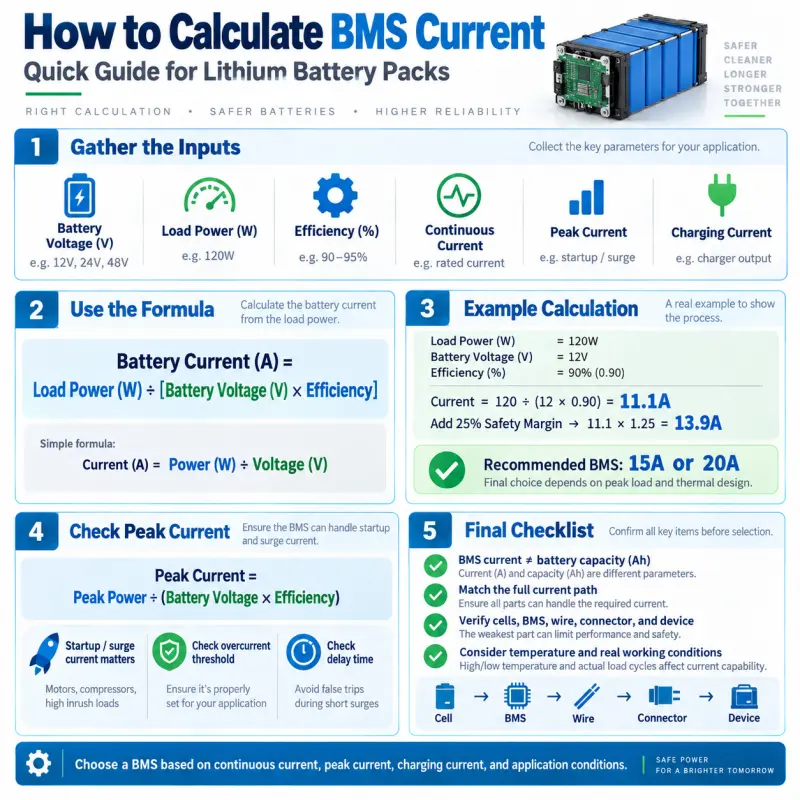
Current (A) = Power (W) ÷ Voltage (V)
For example, if a 12V battery supplies a 60W load:
60W ÷ 12V = 5A
The load requires approximately 5A.
However, real battery systems are often more complicated because the voltage changes during discharge and the system may use a DC-DC converter, inverter, motor controller, or other power electronics.
In these cases, efficiency should also be considered.
A more practical formula is:
Battery Current = Load Power ÷ (Battery Voltage × Efficiency)
Should I Use Nominal Voltage or Minimum Battery Voltage?
For constant-power loads, using only nominal battery voltage can underestimate the maximum battery current.
Suppose a 4S lithium-ion battery has:
- Nominal voltage: 14.8V
- Lower operating voltage: approximately 12V
- Load power: 120W
- Power conversion efficiency: 90%
At nominal voltage:
120 ÷ (14.8 × 0.90) = 9.0A
At 12V:
120 ÷ (12 × 0.90) = 11.1A
The battery current increases as battery voltage falls.
For this reason, BMS current calculations should consider the lowest expected operating voltage, especially for equipment that tries to maintain relatively constant output power.
How Much Safety Margin Should I Add?
A BMS should normally not operate continuously at its absolute current limit.
A practical starting point is to provide some current margin above the calculated continuous load.
For example:
Required BMS Current = Maximum Continuous Current × Safety Factor
If the calculated continuous current is 11.1A and a 25% margin is used:
11.1A × 1.25 = 13.9A
A BMS with a continuous current rating above approximately 14A would therefore be required from a basic current calculation perspective.
In practice, selecting a 15A or 20A design depends on factors such as PCB temperature, MOSFET performance, battery enclosure, airflow, wire size, connector rating, and peak current.
A larger current number printed on a BMS does not automatically mean the complete battery pack can safely deliver that current.
How Do I Calculate Peak BMS Current?
Continuous current and peak current should be calculated separately.
Many devices briefly require much higher current during:
- Motor startup
- Pump startup
- Wireless transmission
- LTE/5G communication
- Compressor startup
- Servo movement
- High-power LED activation
- Power-tool acceleration
Suppose the previous 12V operating battery briefly supplies a 220W peak load at 90% efficiency.
The approximate peak current is:
220 ÷ (12 × 0.90) = 20.4A
The selected BMS must therefore tolerate this peak current for the required duration.
It is not enough to look only at the BMS continuous rating. You should also check:
| BMS Parameter | What to Check |
|---|---|
| Continuous discharge current | Normal operating load |
| Peak discharge current | Maximum temporary load |
| Peak duration | How long the peak can be supported |
| Overcurrent threshold | Current level that triggers protection |
| Detection delay | How quickly protection responds |
| Recovery condition | How the BMS resumes operation |
This is especially important for motors and communication equipment because a current spike may be normal operation rather than a fault.
Is BMS Current the Same as Battery Capacity?
No.
Battery capacity is measured in Ah, while current is measured in A.
For example, two batteries may both be 20Ah but have completely different applications.
One 20Ah battery may power a 2A device for many hours.
Another 20Ah battery may supply a motor requiring 30A continuously and 60A during startup.
Their capacity is the same, but their BMS requirements are very different.
This is why choosing a BMS simply by battery capacity can lead to incorrect sizing.
How Does Cell Configuration Affect BMS Current?
The BMS cannot safely deliver more current than the battery cells themselves can support.
For cells connected in parallel, the load current is shared between the parallel cells.
For example, a 4P configuration ideally divides pack current across four parallel cells.
If the battery supplies 20A:
20A ÷ 4 = approximately 5A per cell
However, actual current sharing depends on cell consistency, resistance, temperature, busbar design, and connection quality.
The selected cells must therefore support the required current under the real operating conditions.
The complete current path should be evaluated together:
Cell → Nickel/Busbar → BMS → Wire → Connector → Device
A 40A BMS does not make a battery a 40A battery if the cells or connector can only safely support 10A.
How Do I Calculate the BMS Charging Current?
Charging current should also be checked separately from discharge current.
The BMS charging path must support the maximum current supplied by the charger.
For example, if the battery charger provides a maximum current of 5A, the BMS charge circuit must safely support at least that operating condition.
However, the final charging current must also remain within the limits of the battery cells.
Do not increase the charging current simply because the BMS has a higher current rating.
Cell specification, temperature, charging voltage, and battery configuration still determine the acceptable charging conditions.
Is BMS Current the Same as Overcurrent Protection?
No.
This is an important distinction.
A BMS may have a rated continuous current of 20A but an overcurrent protection threshold considerably above 20A.
The continuous rating describes the current the BMS is designed to carry during normal operation.
The overcurrent threshold determines when the BMS considers the current abnormal and disconnects the battery.
For example, a system might operate continuously below 20A but briefly allow a higher startup current before protection activates.
The exact values depend on the MOSFETs, sensing circuit, PCB design, firmware, temperature, and application requirements.
Do I Need a BMS or Only a PCM?
Not every lithium battery requires a complicated smart BMS.
Small 1S lithium polymer batteries may only require a basic protection circuit providing:
- Overcharge protection
- Over-discharge protection
- Overcurrent protection
- Short-circuit protection
Larger multi-series battery packs may require cell monitoring, balancing, SOC calculation, communication, and more advanced protection.
If you are unsure which architecture is appropriate, read BMS vs PCM: What Is the Difference in Lithium Battery Packs?.
What Should I Send to a Battery Manufacturer?
When asking a manufacturer to calculate BMS current, provide as much real load information as possible.
The most useful information includes:
| Required Information | Example |
|---|---|
| Battery voltage | 14.8V |
| Capacity | 5Ah |
| Continuous load | 8A |
| Maximum continuous load | 12A |
| Peak current | 25A |
| Peak duration | 3 seconds |
| Charging current | 3A |
| Operating temperature | -10°C to 45°C |
| Connector | Specified model |
| Application | Medical device / robot / POS / industrial equipment |
For products with motors, wireless modules, pumps, heaters, or other intermittent loads, providing a real current waveform is even more useful.
At GLOFLUX, the battery cells, BMS or protection circuit, wiring, connector, NTC, mechanical structure, and actual load requirements can be evaluated together when developing a custom lithium battery pack.
Final Thoughts
The simplest BMS current calculation starts with:
Current = Power ÷ Voltage
But a reliable battery design should go further.
You should calculate continuous current, peak current, charging current, minimum-voltage current, efficiency losses, and reasonable operating margin separately.
The BMS must also be matched with the cells, wiring, connectors, PCB, thermal design, and actual application.
In other words, the correct question is not simply:
“How many amps should my BMS be?”
A better question is:
“What current does my battery need to deliver continuously and temporarily under the worst normal operating condition?”
Once that information is clear, selecting the correct BMS becomes much easier.
FAQ
How do I calculate the correct BMS current?
Calculate the maximum battery-side continuous current using load power, battery voltage, and system efficiency. Then check peak current separately and provide appropriate operating margin.
Does a 100Ah battery need a 100A BMS?
No. Battery capacity and BMS current are different parameters. A 100Ah battery may use a much smaller or larger BMS depending on the actual load.
Can I use a higher-current BMS than required?
Yes, provided the voltage, chemistry, protection settings, cells, wires, and connectors are compatible. A higher BMS rating does not increase the safe current capability of the cells.
How much current margin should a BMS have?
A 20–30% margin above normal maximum continuous current can be a useful starting point, but the final value should be verified according to thermal performance, peak load, and BMS design.
What happens if the BMS current rating is too low?
The BMS may overheat or trigger overcurrent protection during normal operation, causing unexpected battery shutdowns.
Should motor startup current be included when selecting a BMS?
Yes. Motors can draw much higher current during startup, so both peak current and peak duration should be checked against the BMS protection settings.
Talk to the Manufacturer
Resources & Insights

High Capacity Lithium Battery for Wearables: High-Voltage LiPo Cell Design
2026-10-19
Cylindrical Battery Packs for Laptops: 2S vs 3S vs 4S Battery Design
2026-10-19

Stage Lighting Battery Pack: Prevent Voltage Drop & LED Flicker
2026-10-19

Best Rechargeable Batteries for Smart Devices: Performance, Safety, and Selection Guide
2026-10-19


