


 Home /
BMS vs PCM: What Is the Difference in Lithium Battery Packs?


Table of Contents
- What Is a PCM in a Lithium Battery?
- What Is a BMS?
- BMS vs PCM: What Are the Main Differences?
- When Is a PCM Usually Enough?
- When Should You Use a BMS?
- Is a BMS Always Better Than a PCM?
- What About Multi-Cell Battery Packs?
- Does a 1S Lithium Battery Need a BMS or PCM?
- What Should You Confirm Before Choosing?
- Can GLOFLUX Customize PCM and BMS Solutions?
- Final Thoughts
- FAQ
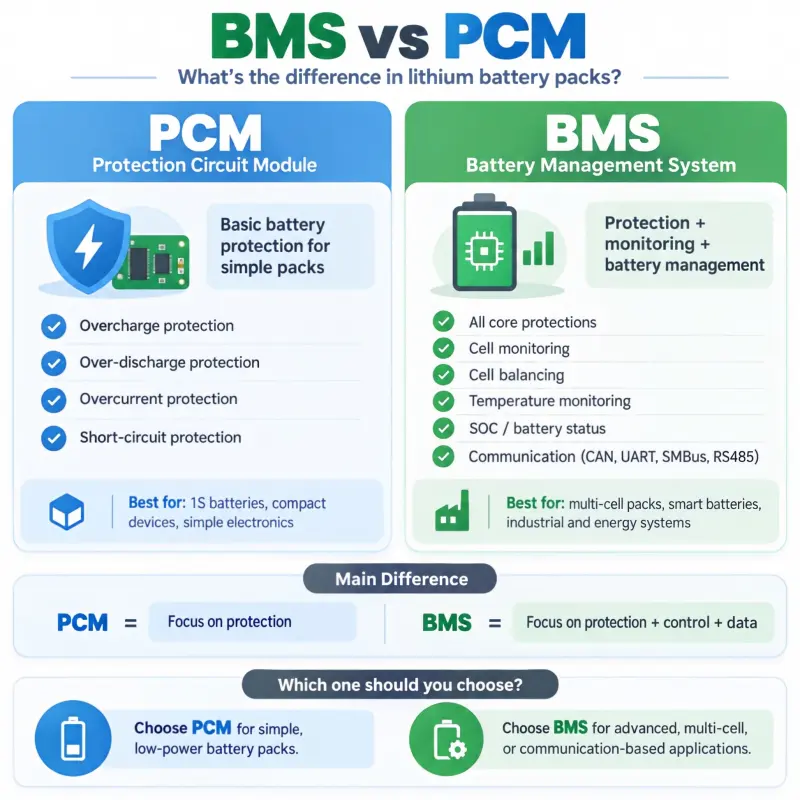
When developing a lithium battery pack, you may often see two terms: BMS and PCM. Both are related to battery protection, and both can help prevent unsafe operating conditions. Because of this, they are sometimes treated as if they mean the same thing.
Actually, they are not exactly the same.
A PCM is mainly designed to provide basic electrical protection for lithium cells, while a BMS can offer more advanced monitoring, management, communication, and control functions.
Understanding the difference between BMS and PCM can help engineers avoid over-designing a simple battery pack or, on the other hand, using a protection circuit that is too basic for a more demanding application.
What Is a PCM in a Lithium Battery?
PCM stands for Protection Circuit Module.
Its main job is to protect the lithium battery from operating outside safe electrical limits.
A typical PCM may provide:
- Overcharge protection
- Over-discharge protection
- Overcurrent protection
- Short-circuit protection
Some PCM designs may also include an NTC temperature sensor or other additional protection functions.
For small lithium polymer batteries and relatively simple battery packs, a PCM is often enough.
For example, a compact 1S lithium polymer battery used in a portable electronic device may only need basic protection against excessive charging, deep discharge, and abnormal current.
In this type of application, adding a complicated smart BMS may not provide much practical benefit.
What Is a BMS?
BMS stands for Battery Management System.
A BMS can perform basic battery protection just like a PCM, but it can also manage much more information about the battery pack.
Depending on the design, a BMS may monitor:
- Individual cell voltage
- Pack voltage
- Charge and discharge current
- Cell temperature
- State of charge (SOC)
- State of health (SOH)
- Remaining capacity
- Cycle count
- Cell imbalance
- Fault conditions
Advanced BMS solutions can also communicate with the main device through CAN, RS485, UART, SMBus, I2C, Bluetooth, or other protocols.
If you are still deciding what type of BMS your battery requires, you can also read our guide on How to Choose the Right BMS for a Lithium Battery Pack.
BMS vs PCM: What Are the Main Differences?
The easiest way to understand the difference is that a PCM mainly focuses on protection, while a BMS focuses on protection plus battery management.
| Feature | PCM | BMS |
|---|---|---|
| Overcharge protection | Yes | Yes |
| Over-discharge protection | Yes | Yes |
| Overcurrent protection | Yes | Yes |
| Short-circuit protection | Yes | Yes |
| Temperature monitoring | Optional/basic | Usually supported |
| Cell voltage monitoring | Limited | Yes |
| Cell balancing | Sometimes | Common in multi-cell packs |
| SOC calculation | Usually no | Available |
| SOH monitoring | Usually no | Available |
| Communication | Usually no | CAN, UART, RS485, SMBus, etc. |
| Data logging | No | Possible |
| Typical applications | Small/simple batteries | Complex or high-value battery systems |
However, the exact functions depend on the circuit design. There is no rule saying every BMS must include all of these advanced functions.
Some manufacturers also use the terms differently, so the actual specification is more important than the name printed on the drawing.
When Is a PCM Usually Enough?
A PCM is often suitable when the battery system is relatively simple.
Typical examples include:
- Bluetooth devices
- Small consumer electronics
- Portable lighting
- Beauty devices
- Small smart wearables
- Simple 1S lithium polymer battery packs
- Low-power handheld electronics
Suppose a product uses a 3.7V 1000mAh lithium polymer battery and only needs to power a basic portable device.
If the equipment does not need battery communication, SOC reporting, cell balancing, or complicated fault diagnostics, a PCM may be the more practical solution.
It is smaller, simpler, and normally more cost-effective.
This is especially important for compact products where PCB dimensions and battery thickness are limited.
When Should You Use a BMS?
A BMS becomes more useful as the battery system becomes more complex.
For example, consider a battery pack using eight or sixteen cells connected in series. Small voltage differences between the cells can become more significant after repeated charging and discharging.
In this situation, the battery may require individual cell monitoring and balancing.
A BMS is also commonly used when the host device needs to know exactly what the battery is doing.
Typical applications include:
- Energy storage systems
- Medical equipment
- Industrial equipment
- Robotics
- Electric mobility products
- AGVs
- Communication equipment
- High-capacity lithium battery packs
- Smart battery systems
A medical or industrial device, for example, may need the battery to report remaining capacity, temperature, cycle count, or fault information to the host controller.
A simple PCM normally cannot provide this level of information.
Is a BMS Always Better Than a PCM?
Not necessarily.
A more complicated battery management system is not automatically a better design.
The correct solution depends on the application.
If a small single-cell battery only needs basic protection, using a large smart BMS can increase cost, PCB size, standby power consumption, firmware complexity, and development time without creating much additional value.
On the other hand, using only a basic PCM for a high-voltage multi-cell battery may provide insufficient monitoring and management.
The goal should not be to select the most advanced circuit.
It should be to select the circuit that matches the real requirements of the battery pack.
What About Multi-Cell Battery Packs?
Multi-cell battery packs require more attention because every series cell group needs to remain within a safe voltage range.
If one cell group reaches the upper voltage limit before the others during charging, the battery may stop charging early.
If another cell group reaches the lower voltage limit first during discharge, the pack may shut down even though other cells still contain usable energy.
This is why many multi-cell battery systems use a BMS with cell monitoring and balancing.
However, some relatively simple multi-cell battery packs can still use a protection PCB without advanced communication.
Again, the electrical architecture should be based on the real application rather than simply choosing between two names.
Does a 1S Lithium Battery Need a BMS or PCM?
For many 1S lithium batteries, a PCM is enough.
Because there is only one series cell group, there is no need to balance different series groups.
The protection board can monitor the cell for overcharge, over-discharge, overcurrent, and short circuit.
However, some 1S smart batteries may still use a more advanced battery management circuit when the device needs fuel gauging, temperature information, authentication, or communication.
So even for a single-cell battery, the final decision depends on the product.
What Should You Confirm Before Choosing?
Before deciding between a BMS and PCM, it helps to provide your battery manufacturer with clear application information.
Important specifications include:
- Battery chemistry
- Series and parallel configuration
- Nominal voltage
- Battery capacity
- Maximum charging voltage
- Continuous discharge current
- Peak current
- Operating temperature
- Maximum battery dimensions
- Required connector
- NTC requirements
- Communication protocol
- SOC display requirements
- Target certifications
- Expected application
These details allow the protection circuit to be designed together with the cells, wiring, FPC, connectors, and mechanical structure.
Can GLOFLUX Customize PCM and BMS Solutions?
Yes.
Depending on the battery project, GLOFLUX can develop lithium battery packs with basic protection circuits or more advanced BMS solutions.
The design can be adapted to different voltage, capacity, current, space, connector, NTC, communication, and application requirements.
For compact products, PCB dimensions and connector layout can be especially important. For larger battery systems, communication, balancing, thermal monitoring, and system integration may become more important.
The right solution starts with understanding how the battery will actually be used.
Final Thoughts
The main difference between a BMS and PCM is the level of battery management.
A PCM mainly provides essential protection, while a BMS can combine protection with monitoring, balancing, communication, SOC calculation, and other intelligent functions.
For a simple small lithium battery, a PCM may be completely sufficient. For multi-cell, high-capacity, high-power, or smart battery applications, a BMS usually provides more useful management capabilities.
Rather than asking whether BMS or PCM is universally better, it is more useful to ask what the battery needs to monitor, protect, and communicate during real operation.
FAQ
Is PCM the same as BMS?
Not exactly. A PCM mainly provides basic battery protection, while a BMS may also provide monitoring, balancing, communication, SOC calculation, and other management functions.
Can a PCM be used for a lithium polymer battery?
Yes. PCM protection circuits are commonly used in lithium-ion and lithium polymer battery packs, especially small 1S batteries.
Does a BMS include PCM protection functions?
In most cases, yes. A BMS generally includes protection against overcharge, over-discharge, overcurrent, and short circuit, plus additional management functions.
Do all multi-cell batteries need a smart BMS?
No. The required management level depends on the application, series count, current, safety requirements, and whether communication or battery data is needed.
Which is cheaper, BMS or PCM?
A basic PCM is normally less expensive because the circuit and functions are simpler. Smart BMS designs may require additional ICs, sensors, communication circuits, software, and development.
How do I know whether my battery needs a BMS or PCM?
Start with the battery voltage, series configuration, current, temperature range, communication requirements, and application. A battery manufacturer can then determine whether basic protection or a more advanced BMS is appropriate.
Talk to the Manufacturer
Resources & Insights
High Capacity Lithium Battery for Wearables: High-Voltage LiPo Cell Design
2026-10-19
Cylindrical Battery Packs for Laptops: 2S vs 3S vs 4S Battery Design
2026-10-19

Stage Lighting Battery Pack: Prevent Voltage Drop & LED Flicker
2026-10-19
Best Rechargeable Batteries for Smart Devices: Performance, Safety, and Selection Guide
2026-10-19


