


 Home /
 Alkaline vs Carbon Batteries: Which Battery Type Is Right for Your Device?


Table of Contents
- Why Do Different Devices Require Different Batteries?
- What Is an Alkaline Battery?
- What Is a Carbon Zinc Battery?
- Alkaline Batteries vs Carbon Batteries: Key Differences
- Which Battery Should You Choose?
- Battery Usage Tips Many Users Overlook
- Reliability Matters More Than Most People Realize
- Gloflux Commitment to Sustainable Battery Technology
- Conclusion
Many people have experienced the same frustration when using batteries. Two AA batteries may look identical, yet one lasts significantly longer than the other. Some devices require frequent battery replacement, while others can operate for months or even years on a single set.
Most consumers assume this is simply a quality issue. In reality, the problem is often much simpler: the wrong battery type is being used for the application.
Among disposable batteries, Alkaline Batteries and Carbon Zinc Batteries remain the two most common choices worldwide. Although they share similar sizes and appearances, their internal chemistry, performance characteristics, and ideal applications are very different.
Understanding these differences can help users improve device performance, reduce replacement frequency, and lower overall battery costs.
Why Do Different Devices Require Different Batteries?
The answer lies in how devices consume power.
Most battery-powered devices fall into one of two categories:
High-Drain Devices
These devices require large bursts of current in a short period of time.
Examples include:
- RC toys
- Game controllers
- Camera flash units
- Electric shavers
- High-output flashlights
- Portable medical devices
Low-Drain Devices
These devices operate continuously with very low power consumption.
Examples include:
- TV remote controls
- Air conditioner remotes
- Wall clocks
- Wireless mice
- Calculators
- Digital scales
Using the wrong battery type can lead to:
- Shorter runtime
- Reduced performance
- Frequent battery replacement
- Higher operating costs
Selecting the appropriate battery chemistry helps maximize both device performance and battery life.
What Is an Alkaline Battery?
An Alkaline Battery is a primary battery that uses manganese dioxide as the cathode material, powdered zinc as the anode material, and potassium hydroxide (KOH) as the electrolyte.
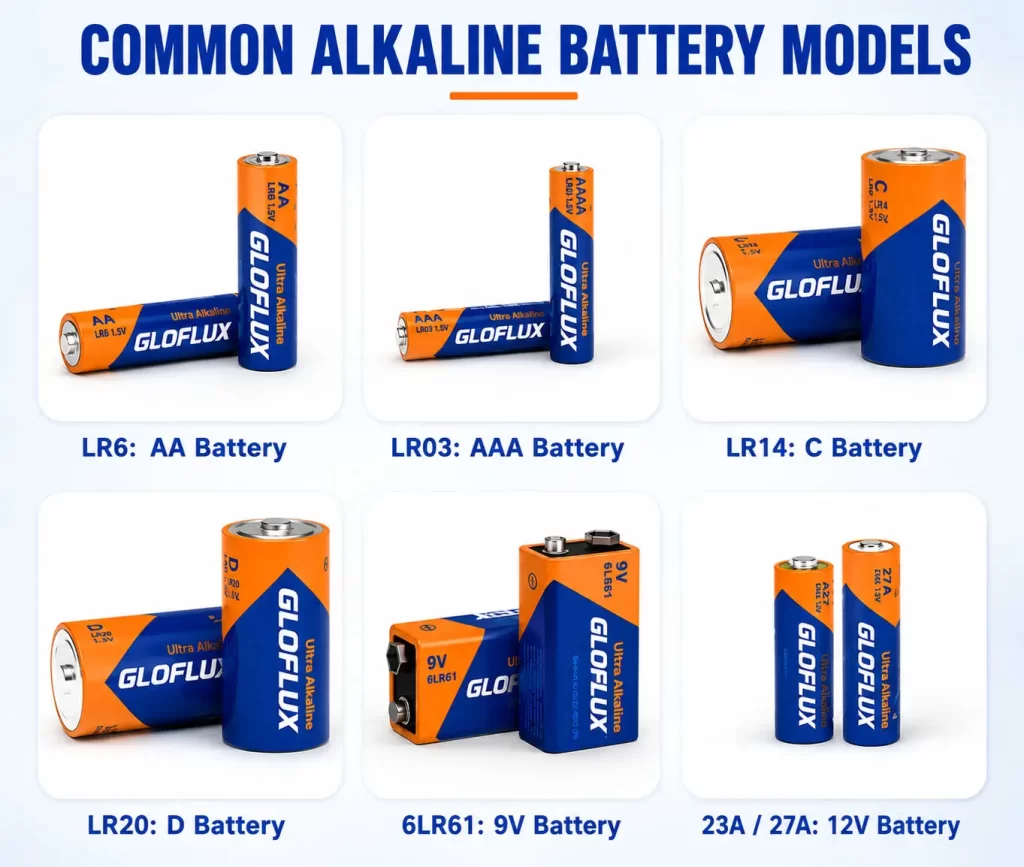
Common models include:
- AA (LR6)
- AAA (LR03)
- 9V (LR61)
Because of its advanced internal design and highly conductive electrolyte, an alkaline battery delivers lower internal resistance and significantly higher energy density than traditional carbon zinc batteries.
Key Advantages of Alkaline Batteries
Higher Capacity
An alkaline battery typically provides three to seven times the capacity of a comparable carbon battery.
For example:
- AA Alkaline Battery: approximately 2,800–3,100mAh
- AA Carbon Battery: approximately 600–850mAh
Better High-Drain Performance
Alkaline batteries can supply higher currents efficiently, making them suitable for power-hungry devices.
Stable Voltage Output
The electrochemical reaction produces a relatively flat discharge curve, helping devices maintain stable performance throughout battery life.
Improved Low-Temperature Performance
Compared with carbon batteries, alkaline batteries perform better in colder environments.
Typical Applications for Alkaline Batteries
Alkaline batteries are recommended for:
- Toys
- Wireless gaming controllers
- Camera flashes
- Electric shavers
- LED flashlights
- Portable medical equipment
- Smart home devices
Any device that requires moderate to high current demand will generally benefit from alkaline battery technology.
What Is a Carbon Zinc Battery?
A Carbon Zinc Battery, sometimes called a Zinc Carbon Battery, is one of the oldest and most widely used primary battery technologies.
The battery uses:
- Manganese dioxide cathode
- Zinc can anode
- Carbon rod conductor
- Ammonium chloride and zinc chloride paste electrolyte
Because the zinc container serves as both the battery housing and the negative electrode, the design remains simple and cost-effective.
Key Advantages of Carbon Batteries
Lower Cost
Carbon batteries are typically less expensive than alkaline batteries, making them attractive for low-drain applications.
Sufficient for Low-Power Devices
Although capacity is lower, many low-drain devices consume so little energy that the difference is often negligible.
Reliable Long-Term Intermittent Use
Carbon batteries perform well in devices that operate occasionally and require minimal current.
Typical Applications for Carbon Batteries
Carbon batteries are ideal for:
- TV remote controls
- Air conditioner remotes
- Wall clocks
- Calculators
- Radios
- Wireless keyboards and mice
- Digital scales
For these applications, carbon batteries often provide a practical and economical solution.
Alkaline Batteries vs Carbon Batteries: Key Differences
| Feature | Alkaline Battery | Carbon Zinc Battery |
|---|---|---|
| Electrolyte | Potassium Hydroxide (KOH) | Ammonium Chloride & Zinc Chloride |
| Anode Material | Powdered Zinc | Zinc Can |
| Cathode Material | Manganese Dioxide | Manganese Dioxide |
| Internal Resistance | Lower | Higher |
| Capacity | 3–7× Higher | Lower |
| Current Output | Excellent | Limited |
| Voltage Stability | Better | Drops More Quickly |
| Low Temperature Performance | Better | Moderate |
| Leakage Resistance | Better | Lower |
| Shelf Life | Longer | Shorter |
| Cost | Higher | Lower |
| Recommended Devices | High-Drain | Low-Drain |
Which Battery Should You Choose?
There is no universal “best” battery.
The right choice depends entirely on the device.
A simple rule of thumb is:
Choose Alkaline Batteries For:
- Toys
- Flashlights
- Gaming accessories
- Cameras
- Portable electronics
- Medical devices
Choose Carbon Batteries For:
- Remote controls
- Clocks
- Calculators
- Wireless peripherals
- Low-power household devices
Matching the battery type to the device's power requirements improves efficiency and lowers total ownership cost.
Battery Usage Tips Many Users Overlook
Proper battery usage is just as important as selecting the right chemistry.
To improve safety and performance:
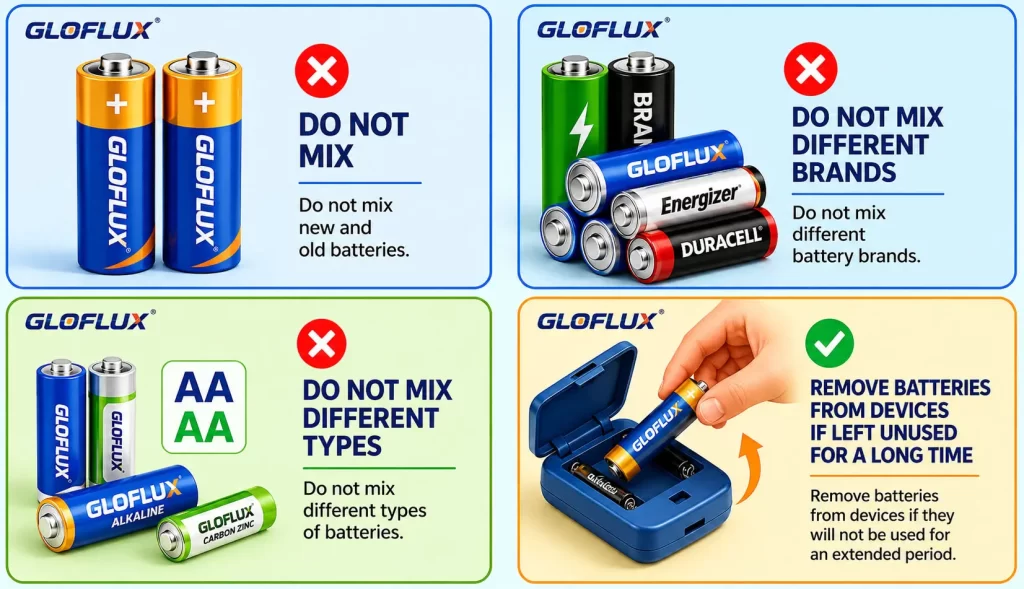
- Do not mix old and new batteries
- Do not mix different battery brands
- Do not mix alkaline and carbon batteries
- Remove batteries from devices that will not be used for long periods
Following these simple guidelines can reduce leakage risk and help extend device lifespan.
Reliability Matters More Than Most People Realize
For consumers, battery performance is about more than just runtime.
Consistency, safety, and reliability play a critical role in overall user experience.
Battery quality depends on many factors, including:
- Raw material selection
- Manufacturing precision
- Quality control procedures
- Capacity consistency
- Safety testing
A well-manufactured battery delivers stable performance throughout its service life and reduces the risk of unexpected failure.
Gloflux Commitment to Sustainable Battery Technology
At Gloflux, we believe reliable energy solutions should also support environmental responsibility.
Our alkaline and carbon battery products are manufactured using mercury-free, cadmium-free, and lead-free formulations that comply with international environmental standards.
We continuously improve:
- Manufacturing efficiency
- Material utilization
- Packaging sustainability
- Environmental performance
As battery technology continues to evolve, Gloflux remains committed to developing higher-performance primary batteries, environmentally responsible materials, and innovative energy solutions for global markets.
Conclusion
Choosing the correct battery type can have a greater impact on device performance than simply selecting a well-known brand.
Alkaline batteries excel in high-drain applications where long runtime and strong power output are essential. Carbon batteries remain a practical and cost-effective choice for low-drain devices.
By understanding the strengths of each battery chemistry and matching them to the appropriate application, users can achieve longer battery life, improved reliability, and lower operating costs.
The right battery does more than power a device—it helps ensure a better experience every day.
Talk to the Manufacturer
Resources & Insights

High Capacity Lithium Battery for Wearables: High-Voltage LiPo Cell Design
2026-10-19
Cylindrical Battery Packs for Laptops: 2S vs 3S vs 4S Battery Design
2026-10-19

Stage Lighting Battery Pack: Prevent Voltage Drop & LED Flicker
2026-10-19

Best Rechargeable Batteries for Smart Devices: Performance, Safety, and Selection Guide
2026-10-19


